
The Question NYC Parents Face
Picture a familiar New York scene: two parents in a Park Slope coffee shop comparing notes about SAT prep. One is leaning toward a big-name group course in Midtown. The other has been told that unless they hire a private tutor at $300–$400 an hour, their child will be at a disadvantage. By the time the conversation ends, both seem less certain than when they began.
That uncertainty is understandable. In New York City, college-admissions anxiety becomes neighborhood folklore fast — traveling through school WhatsApp groups, sideline conversations, and lobby chats at schools from Dalton and Trinity to Beacon, Townsend Harris, and Brooklyn Tech. But the most important decision is not whether another family chose a private tutor or a group class. It is whether the format actually fits your child.
The stakes are real. While "test-optional" shifted the conversation, it did not make strong scores irrelevant. At many highly selective colleges, most admitted students still submit scores, and several major institutions have reinstated testing requirements for recent admissions cycles.
For many New York families, SAT or ACT prep remains a strategic decision. It should not be a status decision.
The right prep path usually comes down to three factors: diagnostic baseline, learning profile, and logistical reality. Start there, and the choice becomes much clearer.
When Private Tutoring Works Best
Private tutoring is the strongest fit when a student needs highly individualized instruction — whether that means reteaching core content, moving at a custom pace, or working around a schedule that would break a standard class format.
Students who tend to benefit most include:
- Students 200+ points below their target score
- Students with foundational gaps in algebra, grammar, or reading comprehension
- Students with ADHD, dyslexia, test anxiety, or executive-function challenges
- High scorers chasing elite results (1,350 → 1,500+)
- Students with demanding extracurricular schedules
That last category matters more in New York than families realize. A student at LaGuardia may be balancing rehearsals and portfolio work. A Stuyvesant student may be juggling advanced STEM coursework and research. A Horace Mann athlete may have practices and weekend competitions that make fixed class schedules impossible. Private tutoring lets the prep plan bend around the student.
Logistics reinforce the case. Families in the Upper East Side or Tribeca can manage in-home tutoring or a short trip to Flatiron, but families coming from Astoria, Bayside, or Riverdale may lose two hours to round-trip subway travel for a single weekday class. Private sessions — at home, at a central office, or virtually — make consistent prep possible when commuting would undermine it.
The tradeoffs are real, though. NYC rates commonly range from $150 to $500+ per hour, and a full 20-session program can run $4,000–$10,000. There is no built-in peer energy, and a tutor can personalize instruction but cannot do the practice for the student.
Choose private tutoring if the diagnostic reveals real skill gaps, the schedule is irregular, or the student needs accountability a classroom cannot provide.
When Group Classes Work Best
Group classes suit students who do not need major reteaching but do need structure, repetition, and test-day discipline. That usually includes:
- Students within 100–150 points of their target
- Strong academics, but inconsistent under time pressure
- Students motivated by peer competition and a fixed weekly rhythm
- Families seeking a lower-cost option
A good group course is not just cheaper private tutoring — it serves a different purpose. It creates momentum, reduces procrastination, and builds stamina through timed drills and full-length proctored practice exams. That last benefit is especially valuable: students at competitive public schools like Beacon, Townsend Harris, or Brooklyn Tech may be academically accomplished yet underprepared for the psychological demands of a high-stakes timed exam.
Where group classes fall short: a preset curriculum may move too fast or too slowly, very high scorers may find instruction too broad, and a long commute to Midtown can turn a strong class into an unsustainable commitment.
Choose group prep if your child is already in range, benefits from structure, and can attend reliably without the commute draining study time.
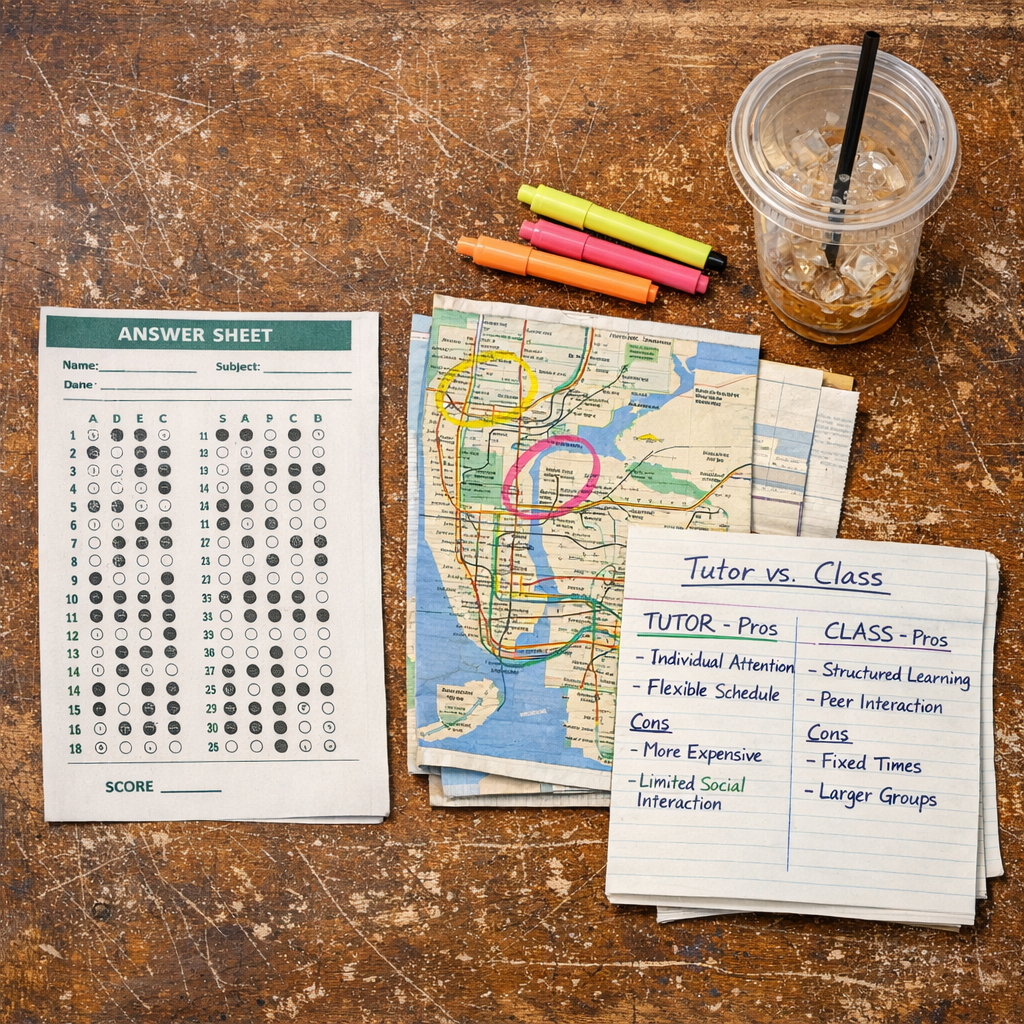
Why Many NYC Families Choose Hybrid Prep
For many students, the smartest answer is not private or group — it is both, in sequence:
- Start with 4–6 private sessions to close foundational gaps
- Transition into a structured group course for pacing, practice exams, and momentum
- Finish with 2–3 private sessions for targeted refinement
This staged approach is already familiar to families from the SHSAT world: build skills first, then sharpen timing under test-like conditions. A sample junior-year timeline targeting the March SAT might look like diagnostics and private sessions in September–October, a group course from November through January, and final private refinement in February.
Cost often lands around $2,500–$5,000 — a better return than either extreme alone. If your child is neither a perfect fit for group nor in need of full private support, a hybrid plan is worth exploring. Programs like GeniusPrep build these paths around an initial diagnostic, which is the right place to start regardless.
The Five Questions Every NYC Parent Should Ask
1. What does the diagnostic say? A full-length diagnostic — with section breakdowns, timing data, and content-gap analysis — answers most other questions. If your child is 200+ points below target, start with private tutoring. Within 100–150 points? A group class may suffice.
2. How does my child actually learn? If your child thrives on peer energy, group is ideal. If they need adaptive pacing and steady oversight, private is the better fit.
3. What does the weekly schedule really allow? Map the week honestly: school dismissal, commute, sports, rehearsals, clubs, weekend obligations. If there are not at least two consistent openings per week, a rigid group format becomes a stressor rather than a support.
4. How much time remains before the target test? With three or more months, either format can work. With only six to eight weeks, private tutoring has the advantage — it compresses instruction and targets the highest-value weaknesses. If your student wants the October 2026 SAT as their last score before November early-action deadlines, serious prep should not begin in late September.
5. What is the real ROI? Compare cost per point gained, not sticker price alone. A $3,000 group course yielding a 120-point gain runs about $25 per point; a $6,000 private program yielding 220 points runs about $27. Those numbers are closer than they look. Ask what kind of student a program is designed to help and what score movement is realistic.
Key Dates and Logistics
For the 2026–27 admissions cycle, the most relevant test dates include the August 22, 2026 SAT, September 19, 2026 ACT, October 3, 2026 SAT, October 17, 2026 ACT, and December 5, 2026 SAT. Registration deadlines fall about two weeks before test day for the SAT and about five weeks before for the ACT, so plan backward.
Rules of thumb: for the October SAT, begin by mid-July; for December, begin by September. Use late-January Regents weeks as intensive study blocks, and avoid launching a new group course in November, when Thanksgiving, application work, and early-decision pressure collide.
Choose the format your child can sustain weekly without burning energy just getting there. For outer-borough families, virtual prep may be the most practical answer.
The Best Format Is the One Your Child Will Actually Use
The strongest prep plan is not the one with the highest hourly rate or the flashiest reputation. It is the one that fits your child's baseline, learning style, and real schedule well enough to produce consistent work over time.
For NYC families, the decision follows a clear order: start with the diagnostic, match the format to the student, pressure-test the logistics, and commit early enough that the timeline is realistic. Private tutoring transforms outcomes for students who need customization. Group classes drive results for students who need structure and momentum. A hybrid plan is often the smartest middle path.
The SAT does not measure how smart your child is. It measures how prepared they are on a specific day, under specific conditions. The right prep format is the first step in closing that gap. A diagnostic and consultation can make the decision clearer before you commit to any single path.
Considering private SAT tutoring? GeniusPrep offers private one-on-one SAT & ACT prep at 928 Broadway, Manhattan. Personalized study plans with transparent pricing at $125/session. Start with a diagnostic.
Explore: How NYC Students Raise SAT Scores | How to Vet a Tutor | SHSAT Prep | ISEE & SSAT Prep
Related reading
- ACT Classes in NYC
- SAT & ACT Prep at GeniusPrep
- NYC Tutoring Guide: 7 Signs Your Child Needs Help (and When Not To)
- How to Vet a Test Prep Tutor in NYC: A Parent's Guide
- When to Start SAT Prep: NYC Grade-by-Grade Timeline
Sources & Further Reading
The information in this article is reviewed against official, authoritative sources. For the most current testing policies, deadlines, and scoring details, always refer to the issuing body:
- College Board — Official SAT resources
- ACT, Inc. — Official ACT test information
- NYC Department of Education
- ERB (Educational Records Bureau) — ISEE/CTP official
- NYS Education Department
This article was fact-checked by the GeniusPrep Tutoring Team. Policies and test structures change — last review: 2026-04.


