
When Should Your Child Start SAT Prep? A Grade-by-Grade Timeline for NYC Families
If you are a New York City parent, you have probably overheard some version of this conversation at school pickup: one parent mentions that their 10th grader has started SAT tutoring, another says their child is "just doing Khan Academy for now," and suddenly you are wondering whether your family is already behind.
That anxiety is understandable. In NYC, academic pressure starts early. Students at specialized high schools like Stuyvesant, Bronx Science, and Brooklyn Tech already know high-stakes testing from the SHSAT. Students at independent schools like Dalton, Trinity, Horace Mann, and Fieldston often begin hearing college counseling guidance in 10th grade. And for families across Brooklyn, Queens, the Bronx, Manhattan, and Staten Island, the question is not just whether the SAT matters — it is when to start SAT prep without turning high school into a four-year stress cycle.
The good news: the ideal SAT prep timeline is not "the earlier, the better." It is the right preparation at the right stage — which is why our SAT prep in NYC starts with a diagnostic that tells you which stage your child is actually at, not which grade they are in. A ninth grader does not need weekly full-length practice tests. A junior probably does need a structured plan. And nearly every student benefits from a phased approach that builds skills before the pressure peaks.
Nationally, roughly 2.2 million students in the class of 2025 took the SAT. Average scores hover around 1030–1060, while New York State averages often run slightly lower because participation is so broad. College Board data has consistently shown that students who invest at least 20 hours of focused practice can improve by 115 or more points over baseline. That is why timing matters: the goal is not to cram but to give your child enough runway to improve deliberately.
Start Early, but Start Smart
For NYC families, the SAT does not exist in a vacuum. It sits alongside Regents exams, AP classes, demanding commutes, extracurriculars, and a college admissions landscape in which testing matters again. Several highly selective colleges — including MIT, Georgetown, Dartmouth, Yale, and Brown — have reinstated test-required or test-recommended policies. Competitive public options closer to home carry weight too: CUNY Macaulay Honors College often attracts applicants with 1400+ SAT scores, while strong SUNY programs at Binghamton and Stony Brook regularly see applicants in the 1300–1450 range.
That does not mean every child needs a perfect score. It means families should think in phases:
- 9th grade: build the academic foundation
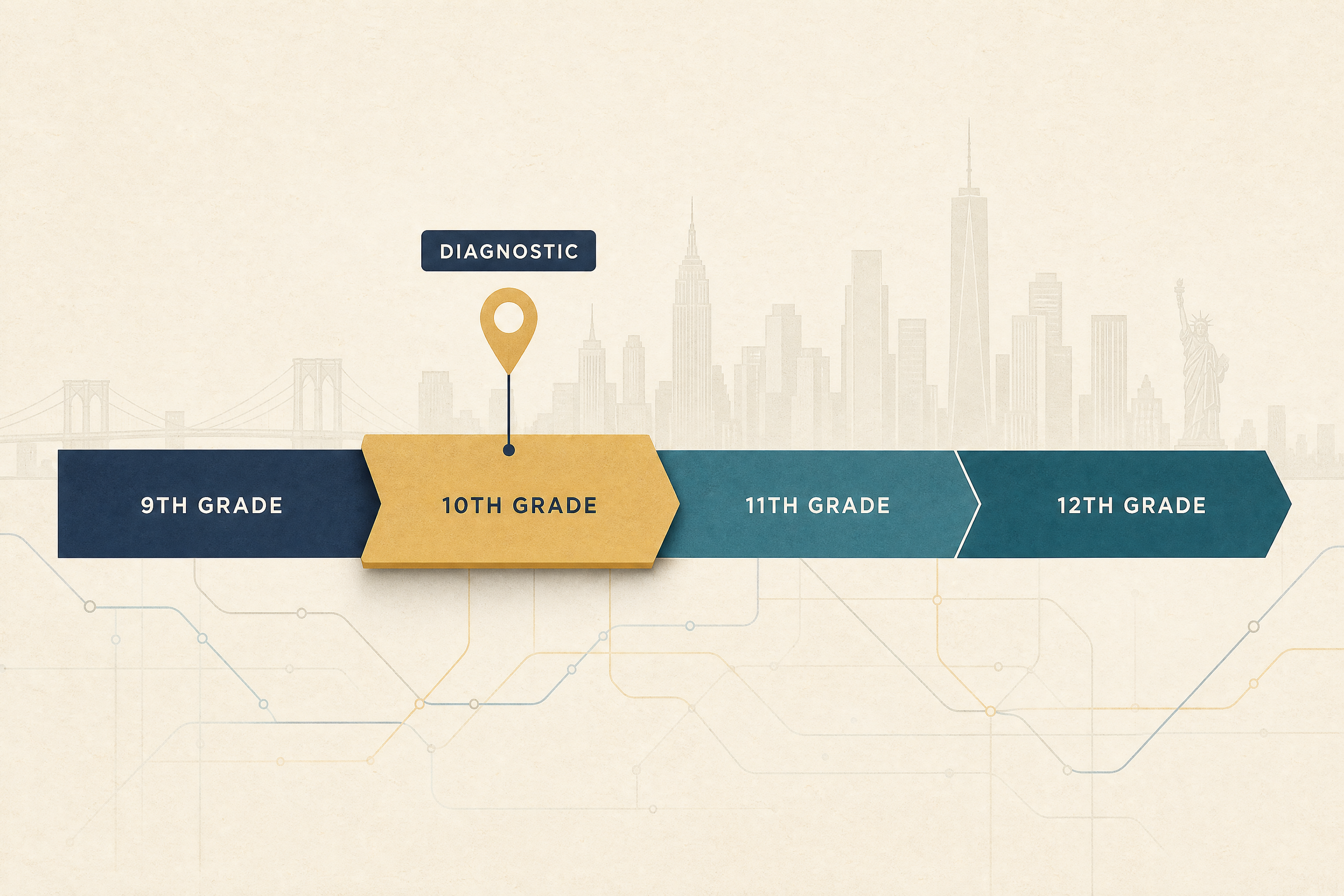
- 10th grade: diagnose strengths and gaps
- 11th grade fall/winter: begin structured prep
- 11th grade spring: peak for the first official SAT
- Senior fall, if needed: retake strategically
One important note: the test has changed. Since March 2024, the SAT has been fully digital — shorter, adaptive, and calculator-permitted throughout the math section. Preparation should focus less on old paper-test endurance and more on digital fluency, timing, and conceptual accuracy.
9th Grade: Build the Foundation Without Calling It SAT Prep
The best SAT prep for most ninth graders does not look like SAT prep at all.
This is the year to build habits that translate into strong scores later, especially in reading and math. Parents do not need to introduce weekly drills or talk constantly about admissions. The goal is to create the academic base that makes future prep easier and far less stressful.
Build reading stamina. Reading and Writing scores are strongly tied to comfort with complex text. A practical target is 30 minutes a day of serious reading — the New York Times, The Atlantic, science journalism, historical nonfiction, or well-argued opinion essays. A student who reads challenging material regularly will have a measurably easier time with the SAT than one who reads only short class assignments.
Understand your child's math sequence. In NYC, math pacing varies widely by school. Some students finish Algebra I in middle school; others follow a more traditional track. Because SAT math draws heavily on algebra, problem-solving, and data analysis, parents should know where their child sits in that pipeline by the end of 9th grade. If foundational algebra is shaky, that is worth addressing now.
Normalize timed academic work. Your ninth grader does not need a full-length SAT, but getting comfortable working accurately under time limits matters. Encourage strong test-taking habits through school exams and short timed practice sets.
Parent action step
Do two things this month: ask your child's math teacher about the expected math sequence through 11th grade, and help your child choose one quality reading source to follow consistently. That is enough for most ninth graders.
10th Grade: The Sweet Spot for Diagnostics
If 9th grade is about building the base, spring of 10th grade is when SAT prep should become visible — but still low-pressure.
This is the ideal window for a first diagnostic. Students are older, more academically mature, and usually far enough along in math for results to be meaningful. It is also early enough to correct weaknesses before junior year gets crowded.
A proper diagnostic should not just produce a score. It should reveal whether Reading/Writing or Math is stronger, which specific skills are lagging, whether timing is an issue, and whether errors are conceptual or careless. To read the number itself in context, compare it against the average SAT score at your child's own NYC high school — a 1150 means something very different at Stuyvesant than it does at a school averaging 950. Parents can use the Bluebook app (the College Board's official digital testing platform) or a professionally administered diagnostic.
As longtime SAT instructor Michael Torres puts it: "The digital SAT rewards adaptability and conceptual fluency, not just memorization. Tenth grade is the sweet spot to begin diagnostic testing and light skill-building."
After the diagnostic
Resist the urge to sign up for the most intense program available. A typical 10th-grade plan looks like:
- 2–3 hours per week of targeted work on weaknesses
- Sitting for the PSAT 10, if the school offers it
- Keeping grades as the primary focus
If parents around you are already talking about tutors, summer intensives, and "building a college profile," take a breath. Your job in 10th grade is not to win the comparison game — it is to figure out what your child actually needs.
Parent action step
Before summer, make sure your child has taken one official-style digital diagnostic, identified two or three concrete skill gaps, and planned a light summer routine. For many NYC students, the summer between 10th and 11th grade is the highest-leverage prep window of the entire process.
11th Grade: Structured Prep and Test Day
By September or October of junior year, students should move into structured preparation — whether a group class, private tutoring, or disciplined self-study with a clear schedule. The weekly commitment should rise to 4–6 focused hours.
The calendar fills fast. NYC juniors are balancing AP and honors coursework, fall activities, the October PSAT/NMSQT, midterms, and — for many public school students — January Regents exams. Families often underestimate how much Regents season disrupts momentum, and not every Regents costs the same: our Regents difficulty data shows which exams have the lowest pass rates statewide, which is where January study time will actually go. Plan SAT work around that reality rather than pretending your child can do everything at once.
A solid prep plan includes three elements: content review to fill genuine knowledge gaps, timed section practice to build pacing and decision-making, and full-length tests every two to three weeks with detailed review afterward. The review piece is critical — a practice test only helps if your child understands why they missed what they missed.
The October PSAT/NMSQT deserves attention. It is a low-stakes dress rehearsal for the SAT, qualifies top scorers for National Merit recognition, and provides useful feedback for every student who sits for it.
Spring: peak performance
For most NYC juniors, the smartest first SAT target is March or May. That timing allows enough academic maturity for a strong performance and still leaves room for a retake in August or October of senior year if needed.
In the 6–8 weeks before the target test, students should increase prep to 6–8 hours per week, emphasizing full-length timed practice under realistic conditions.
NYC logistics matter. Popular test centers — Stuyvesant, Murry Bergtraum, Baruch College Campus High School — fill quickly. Register 6–8 weeks early if location matters; the test registration planner will tell you the exact date that falls on for a March or May sitting. For the digital SAT, confirm the testing device is ready and fully charged, pack a charger, verify ID and arrival instructions, and plan the commute in advance.
As former NYC DOE leader Dr. Karen Webber-Ndour notes: "The biggest mistake I see NYC families make is treating the SAT as a senior-year emergency." The strongest performances come when the test feels like a rehearsed performance, not a crisis.
What If You Are Starting Late?
Many families do not think seriously about the SAT until spring of junior year. If that is you, the strategy simply needs to change.
- Take a diagnostic immediately
- Choose one target test date
- Build an 8–12 week intensive plan focused on the highest-value weaknesses
With a shorter runway, 80–120 points of improvement is a realistic goal with strong effort. Bigger jumps are possible, but be wary of magical promises — six weeks of cramming rarely produces the 200-point leap people imagine.
The summer between junior and senior year can still be highly effective, with the August SAT as a strong target. Test-optional policies may factor into your child's college list, but because more institutions are reinstating testing requirements, that decision should be strategic, not a default.
The Right Time Is the Time That Fits Your Child
The central lesson for NYC parents: your child does not need to start SAT prep earliest. Your child needs to start intentionally.
A ninth grader needs reading habits and math awareness. A tenth grader needs a diagnostic and targeted skill-building. A junior needs structure, repetition, and a clear test-day strategy. That phased approach works whether your child attends a specialized high school, an independent school on the Upper East Side, or a public high school in Queens or the Bronx. It also makes the process calmer — and in a city where students already carry a heavy load, good planning is the best stress reduction tool available.
For families who want expert help mapping out that timeline, GeniusPrep works with students at every stage — from early diagnostics to junior-year test preparation — with virtual support and in-person sessions at 928 Broadway, Suite 1206 in Flatiron/NoMad, convenient to the N/R/W, 6, F/M, and PATH. The best prep plans are never one-size-fits-all. They reflect the student in front of you.
When should your child start SAT prep? Start now — at the level that makes sense for their grade, their schedule, and their goals.
Ready to start SAT prep? GeniusPrep's SAT & ACT preparation program offers private one-on-one tutoring with personalized study plans at 928 Broadway, Manhattan. Book a diagnostic session.
Related: Evidence-Based Study Techniques | SHSAT Prep | ISEE & SSAT Prep
Ready to get started? See our transparent pricing and book a diagnostic session.
Related reading
- ACT Tutoring in NYC
- SAT & ACT Prep at GeniusPrep
- How Much Does SAT Prep Cost in NYC? (2026 Pricing Guide)
- ACT Classes in NYC: 2026 Prices Compared ($300–$3,500)
- How to Vet a Test Prep Tutor in NYC: A Parent's Guide
Sources & Further Reading
The information in this article is reviewed against official, authoritative sources. For the most current testing policies, deadlines, and scoring details, always refer to the issuing body:
- College Board — Official SAT resources
- ACT, Inc. — Official ACT test information
- NYC Department of Education
- ERB (Educational Records Bureau) — ISEE/CTP official
- NYS Education Department
This article was fact-checked by the GeniusPrep Tutoring Team. Policies and test structures change — last review: 2026-04.


