
On a fall morning in New York City, thousands of eighth graders file into testing rooms carrying their test tickets and the kind of nerves that can make a 13-year-old feel far older than they are. For many families, the Specialized High Schools Admissions Test, or SHSAT, is more than an exam. It is a shot at one of the most respected public-school educations in the country.
That pressure is understandable. Each year, roughly 26,000 students sit the SHSAT, yet only about 4,000 offers go out across the eight test-based specialized high schools (26,123 test-takers and 4,023 offers for 2026 admissions). In practical terms, roughly one test-taker in six or seven receives an offer. Between shifting deadlines, opaque cutoff scores, and school rankings that vary by source, the process can overwhelm parents fast.
The good news: it becomes far more manageable once you understand what the schools are, how the SHSAT works, and what a realistic preparation timeline looks like — which is the whole point of our 1-on-1 SHSAT prep in NYC. If you only need the list of schools, it lives on its own page: the full table — 2026 lowest qualifying scores and offers for all 8 schools. This guide is about how to prepare your child for it, month by month.
Reading the official handbook? See our SHSAT Handbook 2026 decoded for a page-by-page walkthrough of what NYC parents actually need to read.
What Each School Needs: Eight by SHSAT, One by Audition
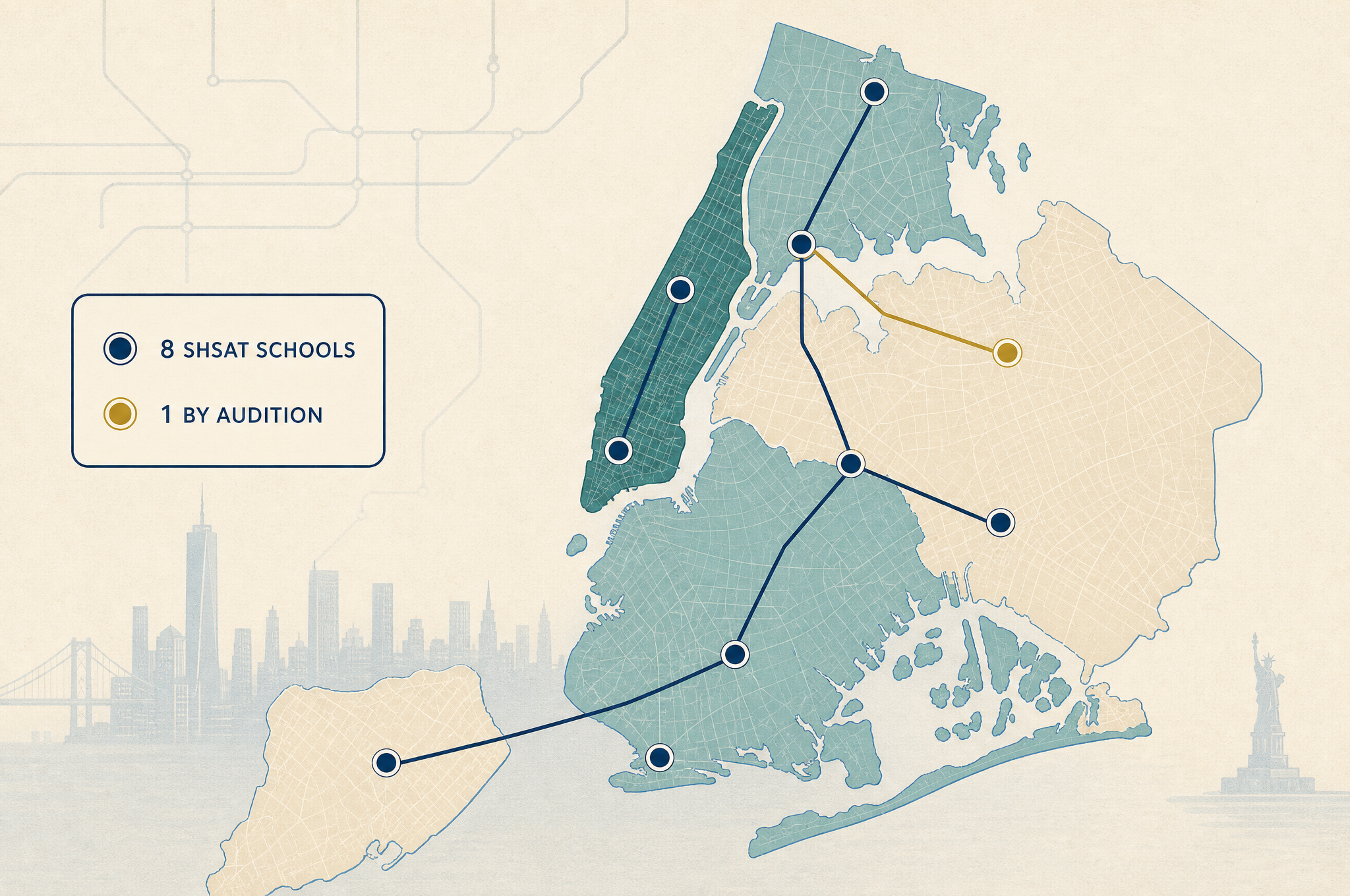
New York City has nine specialized high schools: eight admit on the SHSAT score alone, and LaGuardia admits through auditions and portfolio review, so an SHSAT score plays no part there.
In 2026 admissions, the lowest score that received a ninth-grade offer ran from 495 (Brooklyn Latin) to 561 (Stuyvesant), according to the NYC Department of Education's Specialized High Schools page; turning that record into a realistic goal for one child is where our 1-on-1 SHSAT preparation starts.
For the school-by-school picture, see all eight specialized high schools, with offers and 2026 cutoffs; once your child has a composite score, our SHSAT score calculator places it against each school's line.
Those cutoffs are citywide. To see how many students from your child's own middle school sat the SHSAT and how many received an offer, look the school up in our SHSAT results by middle school, built from the Department of Education's counts.
Understanding the SHSAT
The SHSAT is simple in structure and complicated in effect. Students have 180 minutes to answer 100 questions — 50 in English Language Arts and 50 in Math — and choose which section to begin with. Beginning with the fall 2026 administration, the test is computer-adaptive: after each answer the system re-estimates the student's score and adjusts the difficulty of what comes next, while every student still answers the same number of questions. Most questions must be answered before the next one appears, and once a section is submitted it cannot be reopened.
That format means the exam is not just testing knowledge. It is testing how efficiently a student can reason, read, decide, and recover under sustained pressure.
As one composite expert perspective in GeniusPrep's research brief puts it:
"The SHSAT is a high-stakes, single-sitting exam, and that format rewards a specific kind of preparation. Content mastery alone isn't sufficient. Students need to build test stamina, learn time allocation, and practice under realistic conditions."
What the Test Actually Measures
Many parents assume the SHSAT is simply an advanced version of school math and English. It is not. The exam emphasizes:
- Close reading and inference
- Logical reasoning and problem solving under time pressure
- Math topics that may go beyond the standard seventh-grade sequence, including number properties, logic, and non-routine reasoning
- Endurance across a long testing session
A few common myths are also worth clearing up. You do not need to be a "genius" — preparation and familiarity matter enormously. Math is not the only section that counts; both sections feed the composite score. And rushing through the last questions to finish is not a strategy: scores come from the pattern of right and wrong answers against each question's difficulty, and the DOE advises a real attempt on every item.
What parents should do now: Download the DOE's NYC Guide to the SHSAT for 2027 Admissions. It includes sample questions with answer explanations and is the single best starting point for understanding question style on the new adaptive test.
The Numbers Behind the Competition
The specialized high schools are competitive because seat supply is limited and unevenly distributed.
- About 26,000 students sit for the exam (26,123 for 2026 admissions, between 25,678 and 27,669 over 2022–2026)
- Registration and the test date itself are two separate deadlines, and the first one is easy to miss — the test registration planner works both of them back from the sitting you want
- About 4,000 offers are made (4,023 for 2026 admissions, between 3,994 and 4,072 over 2022–2026)
- Stuyvesant remains the toughest admit; Brooklyn Tech offers the most room
- Smaller schools carry different admissions dynamics and can be exceptional options
The city's admissions data also continues to show significant demographic imbalances. Asian American students have received the largest share of offers at several schools — especially Stuyvesant — while Black and Latino students, who make up the majority of the overall NYC public school population, remain significantly underrepresented.
That context is one reason the Discovery Program matters. The DOE reserves a limited number of seats for economically disadvantaged students who score just below a school's cutoff. The program has expanded in recent years but remains small relative to total enrollment.
"The specialized high schools are extraordinary institutions, but they are not the only path to an extraordinary education in New York City. The most important thing is finding the right fit for your child's learning style, not chasing a single name."
A strong plan is not "Stuyvesant or bust."
What parents should do now: Build a balanced mindset before building a school list. Schools such as Beacon, Bard High School Early College, Eleanor Roosevelt, and Townsend Harris may also belong in your family's broader admissions strategy.
When to Start Preparing
The biggest planning mistake families make is assuming SHSAT prep begins in September of eighth grade. By then, testing is only weeks away.
"The single biggest mistake I see families make is waiting until September of eighth grade to begin preparing. By then, you have roughly six weeks before the exam. A four-to-six-month preparation window is far more realistic for most students."
Phase 1: Spring to Summer Before Eighth Grade
Start with a diagnostic test — not to label your child, but to identify strengths, weaknesses, and pacing issues. Focus on a baseline practice exam, math gap analysis, reading comprehension work, and building a steady reading habit. For many families, this is also when outside support — whether school-based resources, independent study, or a tutoring program — becomes most useful.
Phase 2: September and October
Shift to test-specific preparation: full-length timed practice tests — our free SHSAT practice test is built for exactly this stretch — mistake review by category, pacing strategy for both sections, and endurance practice under realistic conditions. The goal is not endless worksheets. It is a repeatable system.
Register on MySchools between October 6 and October 30. How to register, step by step.
Phase 3: Test Week
Prioritize sleep, predictable routines, transportation planning, and confidence over last-minute cramming.
What parents should do now: Put the timeline on your calendar. For this cycle, registration runs from October 6 to October 30, 2026, the SHSAT School Day falls on November 18, 2026, and results arrive in March alongside the general high school admissions round; we keep the full SHSAT test dates calendar updated as the DOE publishes each remaining date.
Build a Full High School Strategy
The SHSAT does not replace the rest of the NYC admissions process — it runs alongside it. Families should be thinking in at least three lanes:
1. Specialized High Schools. Rank schools thoughtfully. Do not list only prestige names without considering commute, culture, and fit.
2. General NYC High School Admissions. Screened and consortium schools still matter enormously. Depending on your child's profile, Beacon, Eleanor Roosevelt, Bard High School Early College, and Townsend Harris may be important alternatives — or even better fits.
3. Independent or Parochial Options. Some families compare specialized high schools with private schools such as Dalton, Trinity, Horace Mann, or Fieldston, where tuition can exceed $55,000 to $60,000 a year. Others consider rigorous Catholic schools such as Regis, Xavier, or Loyola. These are different systems with different trade-offs in cost, culture, and commute. The specialized high schools remain remarkable precisely because they are tuition-free and academically elite.
For arts-focused students, remember that LaGuardia is a completely separate pathway. A dancer from Jackson Heights, a violinist from Park Slope, or a young actor from Harlem may have a stronger opportunity through LaGuardia's audition process than through the SHSAT.
What parents should do now: Make two lists. One for SHSAT schools. Another for general admissions, private, Catholic, or audition-based schools your family is considering.
If Catholic high schools are on that second list, note that many of them read a separate exam, the TACHS, with its own deadline: for the 2026 cycle, TACHS registration closes October 28, before the SHSAT's, and the test is taken online at home on November 6 or 7. Every date is on our TACHS page, and our free TACHS practice questions show what the four sections look like.
What Parents Should Do Next
If you are feeling overwhelmed, reduce the process to four steps:
- Learn the format. Understand the SHSAT before your child starts preparing for it.
- Get a diagnostic. A realistic baseline saves time and reduces guesswork.
- Make a preparation plan. Spring and summer before eighth grade is the strongest starting window.
- Build a balanced school list. The right outcome is not one famous name — it is a school where your child can thrive.
For families who want more structure, a professional diagnostic assessment or targeted SHSAT tutoring can turn a vague goal into a concrete plan without making the year feel dominated by test prep. The right support should clarify the process, not intensify the stress.
The admissions season will always feel high-stakes in a city as competitive as New York. But families who understand the timeline, use official DOE resources, and prepare steadily are in a far stronger position than those who wait for urgency to force the issue. Your child's potential is not defined by a single test — but thoughtful preparation gives that test a much better chance of reflecting what your child can actually do.
For parents who want expert guidance, GeniusPrep offers SHSAT diagnostic assessments, small-group classes, and one-on-one tutoring from its office at 928 Broadway, Suite 1206. Sometimes the most valuable thing a family can get is not more practice, but a clear plan.
Looking for expert SHSAT prep? GeniusPrep's SHSAT preparation program has helped hundreds of NYC students gain admission to Stuyvesant, Bronx Science, and Brooklyn Tech. Book your diagnostic.
More resources: SHSAT Study Schedule | SAT & ACT Prep | ISEE Prep for Private Schools
Related reading
- SHSAT Prep at GeniusPrep
- SAT & ACT Prep at GeniusPrep
- NYC School Admissions: SHSAT vs ISEE vs Screened Programs
- 3 NYC Families Who Cracked the SHSAT: Real Success Stories
- NYC G&T Admissions 2026: A Parent's Practical Guide
Sources & Further Reading
The information in this article is reviewed against official, authoritative sources. For the most current testing policies, deadlines, and scoring details, always refer to the issuing body:
- College Board — Official SAT resources
- ACT, Inc. — Official ACT test information
- NYC Department of Education
- NYC DOE — High School Admissions
- InsideSchools — Independent NYC school reviews
- NYC DOE SHSAT Handbook
- Stuyvesant High School — Official site
This article was fact-checked by the GeniusPrep Tutoring Team. Policies and test structures change — last review: 2026-04.


