
Five Evidence-Based Study Techniques That Give NYC Students an Edge
At many New York City kitchen tables, the same scene plays out every fall: a middle schooler has been "studying" for three hours, the highlighters are out, the notes are covered in color, and a parent is left wondering why none of it translates into better scores. In a city where academic pressure starts early, that question carries real weight.
The stakes in NYC are unusually high. Roughly 26,000 students take the SHSAT each year for about 4,000 offers, making the margin between acceptance and disappointment razor-thin. Factor in ISEE expectations at selective independent schools like Dalton, Trinity, Collegiate, Brearley, and Ethical Culture Fieldston, plus SAT and ACT benchmarks for competitive college admissions, and effort alone clearly is not enough. Students need the right methods.
That is the part many families never learn. The top-performing students in New York are not always the ones studying the longest — they are the ones using evidence-based study techniques that align with how memory and learning actually work. At schools like Stuyvesant, Bronx Science, Brooklyn Tech, Horace Mann, and Trinity, strong students tend to rely on systems, not just willpower.
Here are the five techniques that consistently make the biggest difference.
1. Spaced Repetition Beats Cramming
Spaced repetition means reviewing material at increasing intervals instead of all at once. Rather than studying vocabulary for two hours on Sunday and then ignoring it, a student reviews on Day 1, Day 3, Day 7, Day 14, and Day 28. Each session strengthens recall just as the brain begins to forget.
The research is strong. In their widely cited 2013 review, Dunlosky and colleagues rated distributed practice as one of the only study techniques with high utility — a distinction few methods earn.
This matters especially in New York, where students juggle demanding school schedules, long commutes, extracurriculars, and multiple testing tracks at once. An eighth grader on the Upper West Side may be preparing for the SHSAT while managing screened-school coursework. A junior in Park Slope may be balancing AP classes, SAT prep, and sports. In both cases, last-minute studying is almost guaranteed to fail.
As Dr. Marcus Ellis, a cognitive psychologist and education researcher at Columbia Teachers College, puts it: "Spaced repetition isn't a hack — it's how human memory actually works. When NYC students are juggling SHSAT prep, school finals, and extracurriculars, the last thing they can afford is a study method that wastes their time."
What Parents Can Do This Week
Build a simple four-week review calendar using index cards, a spreadsheet, or a flashcard app like Anki. For long prep arcs — especially when SHSAT registration opens in October and the test arrives in late October or early November — spacing is one of the easiest ways to turn preparation into durable memory.
2. Active Recall Is What Real Learning Feels Like
Many students confuse recognition with mastery. They look at notes, recognize the material, and conclude they know it — then sit down for a test and realize they cannot produce the answer on their own.
Active recall means pulling information from memory without looking at the answer first. Instead of rereading a geometry chapter, the student closes the book and explains the rules for similar triangles from memory. In a classic 2006 study, Roediger and Karpicke found that students who practiced retrieval retained about 80% of material after one week, compared with just 36% for those who simply reread.
This is one of the biggest reasons hardworking students plateau. Rereading feels smooth. Highlighting gives the illusion of progress. But on the SHSAT, SAT, and ISEE, students are rewarded for precise recall and execution under pressure — not familiarity.
Dr. Anya Krishnamurthy, Director of Academic Programs at GeniusPrep, says: "The biggest mistake I see NYC families make is confusing time spent studying with effective studying. A student who does 45 minutes of active recall will outperform a student who highlights a textbook for three hours. Every time."
How to Apply It
Try the Blank Page Method: after finishing a topic, put away all notes and write down everything remembered on a blank sheet. The gaps reveal exactly what needs more work. Parents can reinforce this informally — ask a few questions at dinner or have your child explain a concept on the subway ride home.
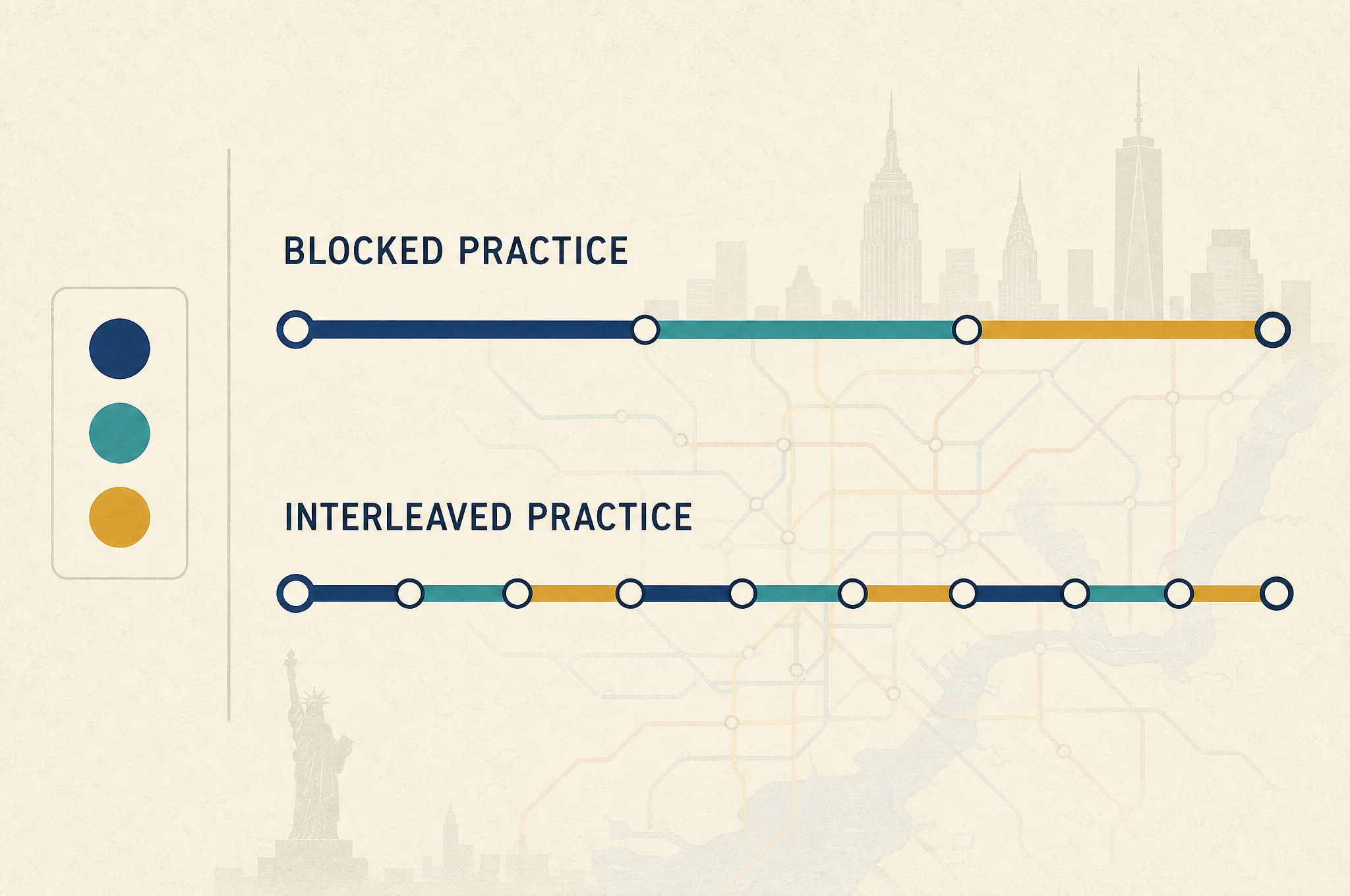
3. Interleaving Prepares Students for Real Tests
Many students practice in blocks: 20 algebra problems, then 20 geometry problems, then 20 vocabulary questions. That builds fluency but makes the work artificially easy. Real exams do not sort problems by type.
Interleaving means mixing different kinds of problems in a single session. Research by Taylor and Rohrer found that interleaving improved delayed-test accuracy by roughly 25% to 43% compared with blocked practice — because it trains students to recognize which method is needed, not just apply one they already expect.
The SHSAT mixes reading, revising/editing, and math in ways that demand flexibility. The SAT requires quick shifts between concepts. The ISEE moves among vocabulary, quantitative reasoning, and reading comprehension. Students who only practice in neat categories often struggle when the test scrambles everything together.
As Linda Ochoa, an 18-year veteran math teacher in NYC DOE District 2, says: "I tell my students: if it feels easy, you're probably not learning. The techniques that feel harder in the moment — testing yourself, mixing up problem types — are exactly the ones that stick."
A Practical Fix
If your child uses a prep book, resist doing one chapter start to finish. Instead, pull problems from multiple chapters, mix difficulty levels, and alternate verbal and math work to mimic actual exam unpredictability.
4. Practice Testing Builds Stamina and Lowers Anxiety
Knowledge is only part of test performance. The other part is accessing that knowledge under time pressure, fatigue, and stress.
Practice testing under real conditions means taking full-length, timed exams at a desk, with no phone, following official timing rules. Dunlosky and colleagues rated it high utility — the same top tier as spaced repetition.
This is critical in NYC because the SHSAT runs for 180 minutes with no break, which surprises many students the first time. The SAT demands sustained focus across adaptive sections. A student who knows the material but has never practiced managing time and recovering after a tough section may underperform anyway.
Schedule weekend morning practice tests starting around 9 a.m. to mimic test-day conditions. That detail matters more than many parents realize. For the SHSAT specifically, our free SHSAT practice test is built to be sat that way, and the SHSAT score calculator turns the raw result into the composite the DOE ranks on.
The Most Important Follow-Up
After every practice exam, students should keep a mistake journal and label each wrong answer:
- Careless error
- Concept gap
- Misread question
- Time pressure
- Trap answer
Over time, patterns emerge. Maybe the student consistently rushes revising/editing questions. Maybe they miss algebra problems not from lack of knowledge but from skipping a step. That insight is often what moves a student from "pretty good" to competitive.
5. Self-Explanation Turns Wrong Answers Into Better Judgment
A surprising number of students review mistakes by checking the answer key, nodding, and moving on. That is not review — it is exposure.
Self-explanation means asking "why?" and "how?" as part of study. Why is choice B correct? Why are A, C, and D wrong? How do I know this is a ratio problem and not a percent-change problem? Research by Chi and colleagues showed this approach significantly improves learning, and Dunlosky rated it moderate utility — especially powerful when paired with retrieval and spaced review.
This technique is particularly effective for SHSAT reading comprehension, SAT reading and writing, ISEE verbal reasoning, and multi-step math where reasoning matters as much as calculation.
For each missed problem, have your child write two to three sentences: Why is the correct answer right? Why did I pick the wrong one? What clue should I notice next time? If a student can explain a concept clearly to a parent who has not seen the worksheet, they probably understand it. If not, they need another pass.
A Weekly Plan That Fits NYC Life
NYC students leave home early, get back late, and often have music, sports, or debate layered on top. The goal is not a seven-day grind — it is making study time more intelligent.
- Monday: 45 min of active recall and interleaved practice
- Tuesday: 30 min of spaced repetition review
- Wednesday: 45 min of mixed verbal and math practice
- Thursday: 30 min reviewing the mistake journal
- Friday: 45 min of active recall plus a short timed section
- Saturday morning: Full-length timed practice test
- Sunday: Deep review using self-explanation; schedule next spaced reviews
For students commuting from Riverdale, the Upper East Side, Brooklyn Heights, or Queens, even travel time can become review time — vocabulary flashcards, oral recall, or concept explanation. Consistency and design matter more than raw hours.
The Real Difference Is Technique, Not Talent
In New York, it is easy to assume top scores come down to raw ability. But what separates a solid student from a standout is whether they know how to study in a way that matches the science of learning.
Spaced repetition, active recall, interleaving, practice testing, and self-explanation are not trendy hacks. They are proven methods that build exactly what selective exams demand: memory, judgment, flexibility, and endurance. They work for students aiming at Stuyvesant, Bronx Science, Brooklyn Tech, Dalton, Trinity, Collegiate, Horace Mann, and beyond. Whichever exam that path runs through, the point of all this practice is a number someone else will read — the free calculators and explainers we publish exist so you can interpret that number the way an admissions office does.
Your child does not need more panic. They need a better system.
If building that system feels overwhelming, outside guidance can help. A thoughtful diagnostic and individualized plan — whether at home or with an experienced tutor — can identify what is actually holding a student back. For families looking for that structure, GeniusPrep's Flatiron office at 928 Broadway works with NYC students across SHSAT, SAT, ACT, and ISEE prep, using the same evidence-based techniques outlined here.
The city's admissions landscape is demanding. But with the right methods, students can prepare with more confidence, more efficiency, and far better results.
Want to apply these techniques with expert guidance? GeniusPrep's tutors integrate evidence-based study methods into every session. Explore our programs: SAT & ACT Prep | SHSAT Prep | ISEE & SSAT Prep. Book a diagnostic.
Related: When to Start SAT Prep | Managing Test Anxiety
Ready to get started? See our transparent pricing and book a diagnostic session.
Related reading
- ISEE Prep at GeniusPrep
- SHSAT Prep at GeniusPrep
- SAT & ACT Prep at GeniusPrep
- NYC Digital SAT Reading & Writing Prep: 5 Key Strategies
- Managing Test Anxiety: A Guide for NYC Students
Sources & Further Reading
The information in this article is reviewed against official, authoritative sources. For the most current testing policies, deadlines, and scoring details, always refer to the issuing body:
- College Board — Official SAT resources
- ACT, Inc. — Official ACT test information
- NYC Department of Education
- Dunlosky et al. — Evidence-based study techniques (Psychological Science in the Public Interest)
- American Psychological Association — Learning and memory
- NYC DOE SHSAT Handbook
This article was fact-checked by the GeniusPrep Tutoring Team. Policies and test structures change — last review: 2026-04.

