
Why the ISEE Feels So High-Stakes in New York City
For many NYC parents, the private school admissions process starts with a jolt. One minute you're casually browsing open houses in Manhattan or Brooklyn; the next you realize application deadlines are only months away and the ISEE is suddenly the most important acronym in your household.
That reaction is understandable. The Independent School Entrance Examination is the admissions test most commonly required by selective private and independent schools in New York City. For families applying to Dalton, Trinity, Horace Mann, Collegiate, Brearley, Chapin, Spence, Fieldston, or Riverdale, competition is fierce — acceptance rates at the most selective entry points can dip into the single digits. In a holistic process that also weighs recommendations, interviews, essays, and school fit, ISEE scores remain one of the clearest quantitative markers admissions offices use to compare applicants.
The good news: strong ISEE performance does not require turning your child into a test-taking machine. As Dr. Margaret Liu-Castillo, Director of Admissions Consulting at Castillo Education Group, puts it: "The biggest mistake I see NYC parents make is treating the ISEE like a standardized state test. It's a reasoning exam. It rewards flexible thinking, not rote memorization."
The smartest approach is not panic or over-scheduling — it is a strategic plan, and a workable plan runs in one order: a diagnostic first, a target score second, a written schedule third. Understand the test, map the timeline backward from deadlines, and prepare in a way that builds confidence rather than burnout.
What the ISEE Tests and What NYC Schools Actually See
The ISEE is administered by the ERB at four levels:
- Primary Level — entry to K and 1st grade
- Lower Level — entry to 2nd through 4th grade
- Middle Level — entry to 5th through 7th grade
- Upper Level — entry to 8th through 12th grade
The most competitive NYC entry points are typically 5th grade and 9th grade, making the Middle and Upper Level versions the focus for most families.
The five sections
Middle and Upper Level students face:
- Verbal Reasoning
- Quantitative Reasoning
- Reading Comprehension
- Mathematics Achievement
- Essay
The test measures both learned academic skills and underlying reasoning ability, which is why some students who excel in school are caught off guard by the format. Quantitative Reasoning feels very different from a standard math worksheet. Verbal Reasoning rewards mature vocabulary and nuance beyond what most classrooms demand.
How scoring works
Schools receive stanine scores on a 1-to-9 scale, normed against same-grade peers nationwide. In competitive NYC applicant pools, families typically aim for 7, 8, or 9 stanines across the core multiple-choice sections. If you already have a score report in hand and the stanine, percentile, and scaled columns are not lining up in your head, our ISEE score explainer translates each one into what an admissions reader actually takes from it.
Numbers alone, however, never tell the whole story. James Whitfield, M.Ed., a former admissions reader at a top-ten NYC independent school, puts it plainly: "Admissions committees look at ISEE scores in context. A 7 stanine from a student at an under-resourced public school may carry more weight than a 9 from a heavily tutored applicant at a feeder school. That said, scores below the 5th or 6th stanine rarely survive initial screening at the most selective institutions."
Don't ignore the essay
The essay is unscored but still sent to every receiving school. Admissions teams use it to gauge voice, structure, maturity, and authenticity. Schools known for closely reading written materials — including Trinity and Ethical Culture Fieldston — treat it as part of the application, not an afterthought. So should you.
Action step: Confirm which ISEE level your child will take and what score range is realistic for your target schools.
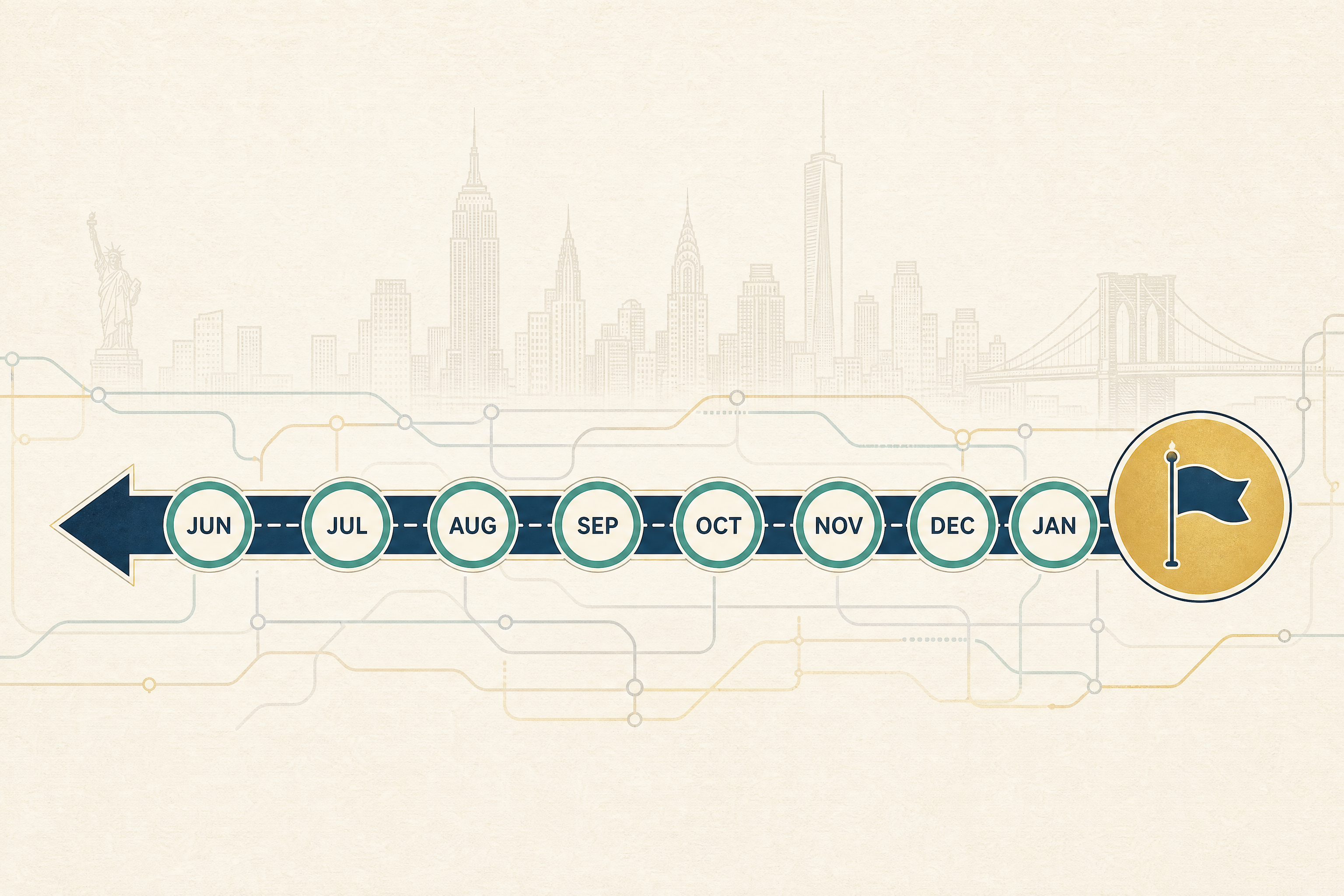
The NYC Admissions Timeline: Planning Backward From the Application Deadline
A common mistake is organizing around the test date instead of the full admissions calendar. In New York, you should plan from the application deadline and work backward. Test dates and registration windows are kept up to date on our ISEE test dates page — use that page for the fixed points, and this one for what your family should be doing between them.
April–June: Research and early positioning. Build a target list across Manhattan, the Bronx, Brooklyn, or Queens. Attend open houses. Learn which schools require the ISEE versus the SSAT; for those that take the SSAT, the paper test runs on one national calendar, set out with its late and rush cut-offs on our SSAT test dates page. Schedule a diagnostic assessment. If you're applying from Park Slope, Brooklyn Heights, Carroll Gardens, the Upper West Side, or Forest Hills, think through commute logistics now.
July–August: Secure the seat and begin structured prep. Seats go early, so register as soon as the window opens — that page walks through the ERB account, the fees, and the NYC test sites that fill first — and keep a backup sitting in reserve. Then start a structured prep plan built around that sitting rather than around the calendar.
September–October: First serious testing window. An early sitting can make sense if your child has completed substantial prep and would benefit from a later retake. The number of attempts your family gets, and the rule that governs them, are set out on the test dates page.
November–December: Final push. Complete final practice tests, sit the test with enough margin before the deadline cluster, and confirm that scores will reach schools in time.
December 15–January 15: Deadline cluster. Applications, recommendations, essays, and test materials for most top NYC independent schools come due in this stretch. Watch for financial aid deadlines through SSS/NAIS, which may arrive earlier than expected.
February–March: Decisions arrive. Admissions and financial aid notifications land in late winter.
Action step: Build one master calendar with every school deadline, interview date, and financial aid requirement. Do not rely on memory. Our test registration planner will back the registration cutoffs out of the sitting you pick, which is the half families most often miss.
Building an Effective ISEE Prep Plan
The most effective preparation starts with data, not wishful thinking.
Start with a diagnostic
A full-length diagnostic estimates your child's current scoring range, reveals section-specific weaknesses, and clarifies whether one test sitting or multiple sittings make sense. A student may appear "good at math" yet struggle with Quantitative Reasoning. Another may earn strong grades but show weaker reading-inference skills or limited vocabulary breadth.
Build a 12–16 week schedule
For most students, 12 to 16 weeks of consistent preparation hits the sweet spot. A typical weekly rhythm includes two to three focused sessions: one skills session for math or verbal, one reading or mixed-practice session, and one timed section or review session. This cadence works better than daily drilling. Children improve more when they have time to absorb feedback, build habits, and return to material with a fresh perspective.
Prep by section
Verbal Reasoning. Vocabulary is one of the biggest differentiators, especially for students from STEM-heavy curricula. Read challenging fiction and nonfiction regularly, learn words in context rather than through isolated flashcards, and practice synonym and sentence-completion questions with explanation.
Quantitative Reasoning. This section tests logic and problem-solving, not routine computation. Practice non-standard question formats, strengthen number sense and pattern recognition, and focus on multi-step reasoning over arithmetic speed.
Reading Comprehension. Even strong readers need strategy. Work across science, humanities, and narrative passages. Teach active reading — annotate, summarize, predict — and require every answer to be supported by textual evidence.
Mathematics Achievement. Closer to school math, but gaps still hurt. Review fractions, decimals, ratios, geometry, and early algebra. Identify topics your child's school hasn't covered yet and build speed without sacrificing accuracy.
Essay. Write six to eight timed essays before test day. Use a clear structure — thesis, evidence, conclusion — and focus on clarity, organization, and legible handwriting for paper-based testing.
Use multiple sittings strategically
Rachel Stern, ISEE Curriculum Specialist and Lead Tutor at GeniusPrep, advises: "Families now face a strategic decision: test early in September for a baseline and again in November, or consolidate prep and aim for one strong sitting in December? For most students, we recommend an October sitting followed by a targeted December retake if needed."
More attempts do not automatically mean better outcomes. An unprepared early sitting wastes an opportunity and can increase anxiety.
Manage the parent's role
Your child takes the test, but the emotional climate starts with you. Frame prep as skill-building, not judgment. Protect sleep, downtime, and extracurricular balance. Avoid discussing score fears in front of your child. Celebrate improvement, not just percentiles.
Action step: Schedule one full-length simulation under real conditions — timed, morning start, desk only, no interruptions. ERB publishes an official practice test for each level; once your child has taken it, our ISEE practice test scorer converts the raw score with ERB’s own tables.
NYC-Specific Realities: Feeder Schools, Borough Trends, and Cost
Private school admissions in New York is not a level playing field. Students from established feeder environments such as Allen-Stevenson, Buckley, Browning, or Nightingale-Bamford often benefit from stronger curricular alignment with ISEE-tested skills and longstanding institutional relationships with receiving schools.
For students coming from NYC public or charter schools, the challenge is usually exposure, not raw ability. Vocabulary expectations, reading nuance, and upper-level reasoning problems may appear earlier or more explicitly on the ISEE than in a student's current school sequence. That gap can be closed — but it requires targeted, early preparation. That is exactly what our ISEE test prep in NYC is built around.
The applicant pool is also broadening. More families from Brooklyn Heights, Park Slope, Williamsburg, and Forest Hills now compete for Manhattan seats, increasing pressure at traditional entry points.
Cost barriers are real. Private tutoring in New York ranges from $150 to $400+ per hour, and seasonal group courses can run into the thousands. Families should ask about fee waivers, scholarships, and lower-cost support when available.
Action step: If your child is not coming from an ISEE-aligned school, start earlier. The goal is more runway, not more pressure.
Common Mistakes — and How to Avoid Them
- Starting too late. If serious prep begins in October for December deadlines, there is rarely time for diagnosis, targeted practice, and a meaningful retake.
- Over-prepping to burnout. Exhausted children do not perform like confident ones, especially younger students.
- Ignoring the essay. Unscored does not mean unread.
- Burning a test attempt too early. Three sittings are valuable only if the student is prepared for each one.
- Treating the ISEE as the entire application. Strong scores help, but they do not replace teacher recommendations, interviews, parent statements, or school fit.
- Skipping realistic simulations. Untimed practice on a couch is not preparation for a long, proctored exam in an unfamiliar setting.
Start Early, Stay Calm, Keep Perspective
The ISEE matters in New York City, but it should not define your child's sense of self or consume your family's entire fall. At its best, preparation builds lasting skills: analytical reading, flexible reasoning, organized writing, and academic confidence.
The most successful families follow the same principles: start with a diagnostic, build a targeted plan, and keep the process in perspective. That approach is calmer, smarter, and usually more effective than last-minute cramming.
If your family wants expert support, a personalized plan and a clear diagnostic baseline can make the process far more manageable. For parents commuting through Flatiron, Union Square, or nearby neighborhoods, GeniusPrep's office at 928 Broadway, Suite 1206 is accessible from major subway lines — and a well-timed assessment can clarify whether your child needs a light-touch tune-up or a more comprehensive prep plan.
NYC private school admissions feels intense because it is. But with the right timeline, the right strategy, and the right support, your child can walk into test day prepared, focused, and far less overwhelmed than most applicants around them.
Need expert ISEE guidance? Our ISEE & SSAT prep program includes diagnostic testing, personalized curricula, and practice exams tailored to your target schools. Start today.
Related: Private School Success Stories | SAT Prep | SHSAT Prep
Ready to get started? See our transparent pricing and book a diagnostic session.
Related reading
- ISEE Prep at GeniusPrep
- NYC G&T Admissions 2026: A Parent's Practical Guide
- NYC School Admissions: SHSAT vs ISEE vs Screened Programs
- SHSAT Guide 2026: NYC Specialized High Schools for Parents
Sources & Further Reading
The information in this article is reviewed against official, authoritative sources. For the most current testing policies, deadlines, and scoring details, always refer to the issuing body:
- College Board — Official SAT resources
- ACT, Inc. — Official ACT test information
- NYC Department of Education
- NYC DOE — High School Admissions
- InsideSchools — Independent NYC school reviews
- ERB — ISEE Overview
This article was fact-checked by the GeniusPrep Tutoring Team. Policies and test structures change — last review: 2026-04.


