
Why the ISEE vs. SSAT Decision Matters More Than NYC Parents Expect
When a seat at Brearley, Trinity, or Collegiate is on the table, the difference between the ISEE and SSAT is not a minor administrative detail — it shapes your child's testing strategy for months and, in some cases, narrows your school list before applications even open. New York City's most selective independent schools admit just 10–20% of applicants at competitive entry points like 6th and 9th grade, and the standardized test is one of four pillars admissions offices weigh alongside transcripts, teacher recommendations, and the all-important interview. Choosing the right exam — and preparing for it with enough lead time — matters in ways that go well beyond the score itself.
This guide covers everything NYC families need: what each test measures, which Manhattan schools prefer which exam, the 2026–27 admissions calendar, a five-step prep framework, and clear answers to the questions parents ask most often.
ISEE vs. SSAT: Side-by-Side Comparison
Before getting into the details of each exam, here is the comparison most families need before making any decision.
| Feature | ISEE | SSAT |
|---|---|---|
| Administering body | ERB (Educational Records Bureau) | EMA (Enrollment Management Association) |
| Most-used levels in NYC | Lower (5–6), Middle (7–8), Upper (9–12) | Middle (5–7), Upper (8–11) |
| Sections | Verbal Reasoning, Quantitative Reasoning, Reading Comp, Math Achievement, Essay | Verbal, Quantitative (×2), Reading, Writing Sample |
| Scoring | Stanines 1–9; scaled 760–940 per section | Scaled 440–710 / 500–800; percentile ranks |
| Retake policy | Once per testing season (3 seasons/year) | Unlimited Standard Saturday + Flex tests |
| Test fee (2026) | ~$220 in-person | ~$185 Standard / ~$310 Flex |
| Guessing penalty | None | −¼ point per wrong answer |
| Key NYC sites | ERB office (East 71st St.), Hunter College | Trinity, Friends Seminary, Browning |
The three differences with the biggest practical consequences are the ISEE's stanine scoring system, its one-sitting-per-season retake limit, and the SSAT's guessing penalty. Each shapes strategy in meaningful ways.
What Is the ISEE?
The ISEE is administered by the ERB (Educational Records Bureau) and comes in four levels: Primary (grades 1–3 admission), Lower (grades 5–6), Middle (grades 7–8), and Upper (grades 9–12). For the majority of NYC families, the relevant levels are Lower, Middle, and Upper.
Section breakdown:
- Verbal Reasoning (vocabulary-in-context and sentence completion)
- Quantitative Reasoning (applied math and number sense)
- Reading Comprehension (passage-based questions)
- Math Achievement (curriculum-aligned computation and problem-solving)
- Essay (unscored, but sent to every school that receives the score report)
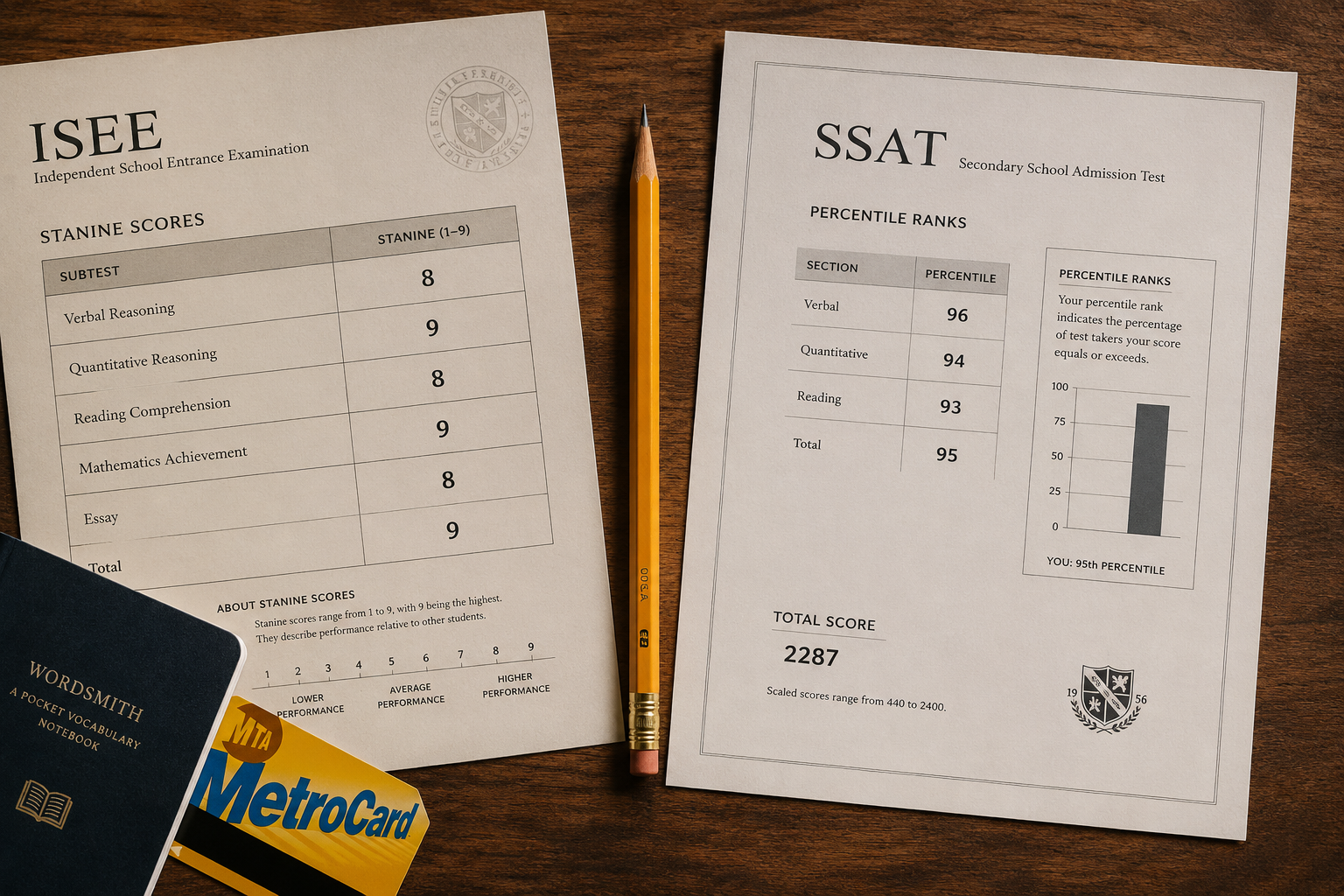
Scores are reported as stanines on a 1–9 scale (9 is highest), derived from scaled scores in the 760–940 range. NYC admissions offices focus almost entirely on stanines rather than raw or scaled scores. A stanine 8 in verbal reasoning means the student outperformed roughly 89–96% of the national norming group. Competitive applicants at Trinity, Brearley, and Collegiate typically present stanines of 7–9 in every section, with 8s and 9s in math and reading common among admitted students.
NYC testing sites: ERB's own office on East 71st Street (Upper East Side), Hunter College, and a rotating set of partner independent schools. These centers fill within two weeks of registration opening — for fall dates, register by early August.
What Is the SSAT?
The SSAT is administered by the EMA (Enrollment Management Association) in three levels: Elementary (grades 3–4), Middle (grades 5–7), and Upper (grades 8–11). NYC applicants most commonly sit the Middle or Upper level.
Section breakdown:
- Verbal (synonyms and analogies — two distinct question formats)
- Quantitative ×2 (two separate math sections)
- Reading (passage-based comprehension)
- Writing Sample (unscored, sent to schools)
Two features distinguish the SSAT strategically from the ISEE:
- Guessing penalty: Each wrong answer deducts one-quarter of a point. Leaving a question blank is sometimes the correct choice — a calculus the ISEE does not ask students to make.
- Score percentiles: The SSAT's percentile pool is self-selected and highly competitive. A 70th percentile score is genuinely strong, and students often underestimate how well they did.
NYC SSAT sites include Trinity School on West 91st Street, Friends Seminary on East 16th Street, and the Browning School on East 62nd Street.
Which Test Do NYC Schools Actually Prefer?
The honest answer is that policies shift year to year — always verify on each school's current admissions page. That said, consistent patterns exist.
Historically ISEE-leaning (as of 2025–26):
- Upper East Side: Brearley, Chapin, Spence, Nightingale-Bamford
- West Side / Upper West Side: Collegiate, Trinity, Columbia Grammar
- Riverdale/Bronx: Horace Mann, Riverdale Country, Fieldston
- Midtown East: Dalton
Either test accepted:
- Avenues: The World School, Grace Church, Berkeley Carroll (Brooklyn), Packer Collegiate (Brooklyn), Poly Prep Country Day
Test-optional or alternative process:
- Saint Ann's (Brooklyn) places heavy emphasis on a writing sample and interview at many entry points — confirm directly with their admissions office.
The ISAAGNY (Independent Schools Admissions Association of Greater New York) coordinates admissions calendars for approximately 140 member schools and standardizes the February 10 notification date for ongoing admissions. Understanding the ISAAGNY framework matters because most top NYC day schools follow it — your family's entire cycle revolves around a single coordinated calendar.
For grades 5–7 applicants choosing between the two tests: verbal-heavy students who excel at synonyms and analogies tend to score better on the SSAT, while students with stronger quantitative reasoning and comfort with dense academic vocabulary often do better on the ISEE. If your target schools strongly prefer the ISEE, that narrows the choice before you ever look at student strengths.
The 2026–27 NYC Admissions Calendar
| Window | Action |
|---|---|
| June–July 2026 | Take a full timed diagnostic; choose ISEE or SSAT; open registration |
| Early August 2026 | Register for fall ISEE sittings — Manhattan centers fill within two weeks |
| August–October 2026 | Structured prep; school open houses and tours; request applications |
| October–November 2026 | Primary ISEE and SSAT testing window |
| Early–mid December 2026 | Most ISAAGNY school applications due |
| December 2026–January 2027 | School interviews; group visits; recommendations submitted |
| February 10, 2027 | ISAAGNY notification day — decisions from most member schools |
| Late February 2027 | Family decision deadline; enrollment contracts due |
A note for late deciders: The December–March testing season exists and works as a fallback, but it compresses interview scheduling and leaves no buffer for a retake. Plan to test in November if at all possible.
How to Prep: A 5-Step Framework for NYC Families
Structured preparation for either test follows a consistent arc. Here is the approach behind our ISEE prep for NYC private schools, applied across all levels.
Step 1: Diagnose Take a full-length, timed practice test under realistic conditions — paper, a kitchen timer, and no breaks beyond what the official test allows. Score it section by section. This baseline reveals whether gaps are primarily verbal, quantitative, or reading-based, and helps determine which test format favors the student.
Step 2: Choose the test Use the diagnostic results alongside your target school list. If Brearley and Horace Mann are on the list, the ISEE is almost certainly the right call. If the list is more varied or Brooklyn-heavy, assess student strengths first.
Step 3: Build a 12–16 week study plan
- Daily: 15–20 minutes of vocabulary (flash cards, morpheme study, and Latin/Greek roots for the ISEE; synonyms and analogies for the SSAT)
- Weekly: Two focused math sessions targeting weak content areas
- Biweekly: One full-length timed practice test
- Monthly: Review all errors categorically — by skill cluster, not question by question
Step 4: Simulate test-day conditions Take at least two practice tests in conditions that mirror the actual exam. GeniusPrep's Flatiron office at 928 Broadway (Suite 1206) hosts diagnostic sessions that replicate the real testing environment — paper bubbling, timed sections, no distractions — which measurably reduces test-day anxiety when the official sitting arrives.
Step 5: Refine and schedule After the second practice test, identify the bottom two stanines or sections by score. Spend the final three to four weeks on targeted remediation there. Schedule the official sitting with enough lead time to allow a retake within a different testing season, though one well-prepared sitting consistently outperforms three rushed ones.
For families juggling concurrent test prep across both the independent school and specialized high school pipelines — Stuyvesant, Bronx Science, and Brooklyn Tech applicants often overlap with private school applicants in timing — SHSAT preparation and SAT prep are worth planning sequentially rather than simultaneously.
What Does Test Prep Cost in NYC?
| Prep Format | Typical Cost |
|---|---|
| Self-study (official guides + Khan Academy) | $0–$75 |
| Group class (8–12 students) | $1,500–$3,500 total |
| Small-group (3–5 students) | $4,000–$7,000 total |
| Private 1:1 tutoring | $200–$500/hour |
| Full 1:1 prep package (16–20 sessions) | $5,000–$15,000 |
Free and low-cost resources: The ERB publishes an official ISEE practice book, and EMA offers an official SSAT guide. Khan Academy covers the underlying math content effectively for both exams at no cost. These are legitimate starting points for self-directed students.
The ROI frame: Top NYC independent schools — Trinity, Dalton, Horace Mann, Brearley, Collegiate — run $64,000–$67,000 in annual tuition for 2025–26. A $3,000 group prep course represents roughly 4–5% of a single year's tuition bill. Families who frame prep as expensive on an absolute basis often underestimate how modest it is relative to the financial commitment the school itself represents.
See GeniusPrep's pricing page for current package options.
Common Mistakes NYC Families Make
These patterns come up repeatedly across admissions cycles:
- Starting in October for a November test. Four to six months of structured prep is standard for competitive applicants. Six weeks is a scramble that shows in scores.
- Choosing the SSAT specifically to retake it repeatedly. EMA score reports sent to schools include all official sittings by default, so admissions officers see every score. Over-testing rarely helps and can signal test anxiety rather than improvement.
- Ignoring the essay. Both the ISEE and SSAT include a writing component that goes directly to schools. It is unscored by the testing organization but read by admissions staff, and a weak essay undermines an otherwise strong application.
- Treating the test as the entire application. At most ISAAGNY schools, the interview and teacher recommendations carry equal or greater weight than the standardized test score. Students who prep only for the test and arrive at interviews underprepared leave points on the table where it counts most.
- Assuming at-home testing is equivalent. Most schools accept at-home scores, but some admissions offices informally treat in-person results as more rigorous. Confirm the policy with each target school before booking an at-home session.
Frequently Asked Questions
Which is harder, the ISEE or SSAT? Neither is objectively harder, but they are hard in different ways. The ISEE's verbal sections demand a broader, more academic vocabulary, and the quantitative reasoning section tests conceptual math in ways that catch underprepared students off guard. The SSAT's percentile pool is self-selected and high-achieving, so scores tend to look lower than students expect — a 65th percentile is genuinely competitive. The harder test is whichever format maps less well to a given student's existing strengths.
Do NYC private schools prefer the ISEE or SSAT? Most top Manhattan day schools historically prefer the ISEE — Trinity, Brearley, Collegiate, Spence, Chapin, Nightingale-Bamford, Horace Mann, and Fieldston among them. Most also accept the SSAT. Saint Ann's and some progressive schools have test-optional or alternative processes. Always verify on each school's current admissions page, since policies shift year to year.
When should my child start prepping? Begin four to six months before the test date. For families targeting November ISEE or SSAT sittings, that means starting no later than June or July. Starting in May or June is better; starting in October is a significant disadvantage at competitive schools.
Can my child take the ISEE more than once? Yes, but only once per testing season. The ISEE has three seasons: August–November, December–March, and April–July. Most NYC families take the exam once in the fall. If a retake is necessary, the December–March season is available, though it compresses the remaining admissions timeline substantially.
What is a good ISEE score for top NYC schools? Competitive applicants at Trinity, Brearley, and Collegiate typically present stanines of 7–9 across all sections. Stanines of 8 and 9 in math and reading comprehension are common among admitted students at the most selective schools. A single stanine 5 in an otherwise strong report is not disqualifying; a pattern of 5s and 6s is a meaningful signal that preparation was insufficient.
Are at-home ISEE or SSAT tests accepted by NYC schools? Most ISAAGNY schools accept at-home scores, but some admissions offices informally treat in-person results as more rigorous. Test in-person if at all possible; use the at-home option only when logistics make in-person testing genuinely unavailable.
How much should we budget for test prep in NYC? Group prep programs typically run $1,500–$3,500. Small-group intensive formats run $4,000–$7,000. Private 1:1 tutoring ranges from $200 to $500+ per hour, with comprehensive packages reaching $5,000–$15,000. Serious self-study using official guides and Khan Academy is a viable option for highly motivated, self-directed students.
What are the key deadlines for the 2026–27 ISAAGNY admissions cycle? Most ISAAGNY school applications are due in early-to-mid December 2026. The standard notification date is February 10, 2027. Family decision deadlines and enrollment contracts typically fall in late February 2027. The primary testing window is October–November 2026.
Sources
- ERB — ISEE Official Site
- EMA — SSAT Official Site
- ISAAGNY — Independent Schools Admissions Association of Greater New York
- NCES — Private School Universe Survey
- NAIS — National Association of Independent Schools
Reviewed by the GeniusPrep Tutoring Team — last updated 2026-06-26.


