
Why These Tests Matter in the NYC Private School Landscape
Every January, thousands of Upper East Side, Park Slope, and Riverdale families open acceptance letters — or don't — and trace the outcome back to a single fall Saturday morning and a test their child sat for in a borrowed gymnasium. The ISEE and SSAT aren't the whole story in NYC independent school admissions, but they are a chapter schools read carefully. With roughly 200 private K–12 schools in New York City coordinating applications through ISAAGNY, and a hard deadline that lands on the second Friday in January, getting the test piece right is non-negotiable.
This guide walks through what each test is, how they differ, which NYC schools care most about each one, and how to build a prep timeline that leaves room for interviews, essays, and the rest of the file.
ISEE vs. SSAT: A Side-by-Side Comparison
The two tests serve the same admissions function but differ in structure, scoring philosophy, and strategic implications.
| Feature | ISEE | SSAT |
|---|---|---|
| Administering body | ERB (Educational Records Bureau) | EMA / SSAT Board |
| Levels | Primary (Gr. 2–4), Lower (5–6), Middle (7–8), Upper (9–12) | Elementary (Gr. 3–4), Middle (5–7), Upper (8–11) |
| Sittings per year | 1 per season (3 seasons: Aug–Nov, Dec–Mar, Apr–Jul) | Multiple — up to 8 Standard Saturdays plus Flex tests per cycle |
| Scoring | Stanines 1–9 plus percentiles | Scaled scores plus percentiles vs. 3-year norm group |
| Wrong-answer penalty | None | Yes — ¼ point deducted (Middle/Upper) |
| Essay | Unscored; sent to schools | Unscored; sent to schools |
| NYC day school fit | Accepted — and lightly preferred — by most ISAAGNY ongoing schools | Universally accepted; dominant for boarding applicants |
| Approximate cost | ~$210 (in-person) | ~$200–$330 depending on test type |
Format Differences Worth Knowing
The ISEE includes five sections: Verbal Reasoning, Quantitative Reasoning, Reading Comprehension, Math Achievement, and an unscored Essay. Total testing time runs about 2 hours 20 minutes at the Middle and Upper levels.
The SSAT includes two Quantitative sections, Verbal, Reading, an Experimental section (unscored, not flagged), and an Essay. Because the SSAT carries a ¼-point wrong-answer penalty, students need a disciplined omission strategy — random guessing works against you. The ISEE's no-penalty structure means students should always answer every question.
The Retake Question
The SSAT's multi-sitting flexibility is genuinely useful — a student who tests in October, identifies weaknesses, and retests in November can meaningfully improve a score. The ISEE's one-sitting-per-season structure demands a more disciplined "best foot forward" approach. Most NYC families applying to January deadlines effectively get one ISEE shot, which raises the stakes for preparation quality.
Which NYC Schools Accept Which Test
The good news: the vast majority of ISAAGNY ongoing schools — the K–12 institutions admitting students at multiple entry points — accept either test. That list includes Dalton, Horace Mann, Riverdale Country, Fieldston, Browning, Allen-Stevenson, Buckley, and Nightingale-Bamford, among others.
That said, there are meaningful tendencies:
- ISEE-leaning schools (historically): Trinity, Collegiate, Spence, Brearley, Chapin. These schools run deep on ERB-ecosystem data, including the in-school ERB assessments administered in NYC private schools K–4, which feed into the same family of norms. Don't confuse those in-school ERB assessments with the ISEE — they're related but distinct.
- SSAT-leaning or SSAT-required: Families applying to boarding schools such as Andover, Exeter, or Hotchkiss need the SSAT, full stop. If a student's list mixes NYC day schools and boarding programs, the SSAT is the efficient choice — it satisfies both.
- Brooklyn schools — Saint Ann's (Brooklyn Heights), Berkeley Carroll, Packer Collegiate, Poly Prep — generally accept either. Saint Ann's is notable for its explicitly holistic, less test-score-driven review.
One important carve-out: many NYC ongoing schools waive standardized testing entirely for "lifers" — in-house students applying from a school's lower division to its middle or upper division. If your child is already enrolled at a school with an upper division, confirm with the admissions office before registering for any test.
The reliable approach is to check each target school's admissions page directly, then cross-reference with ISAAGNY's member directory.
The 2026 Application Timeline: Month by Month
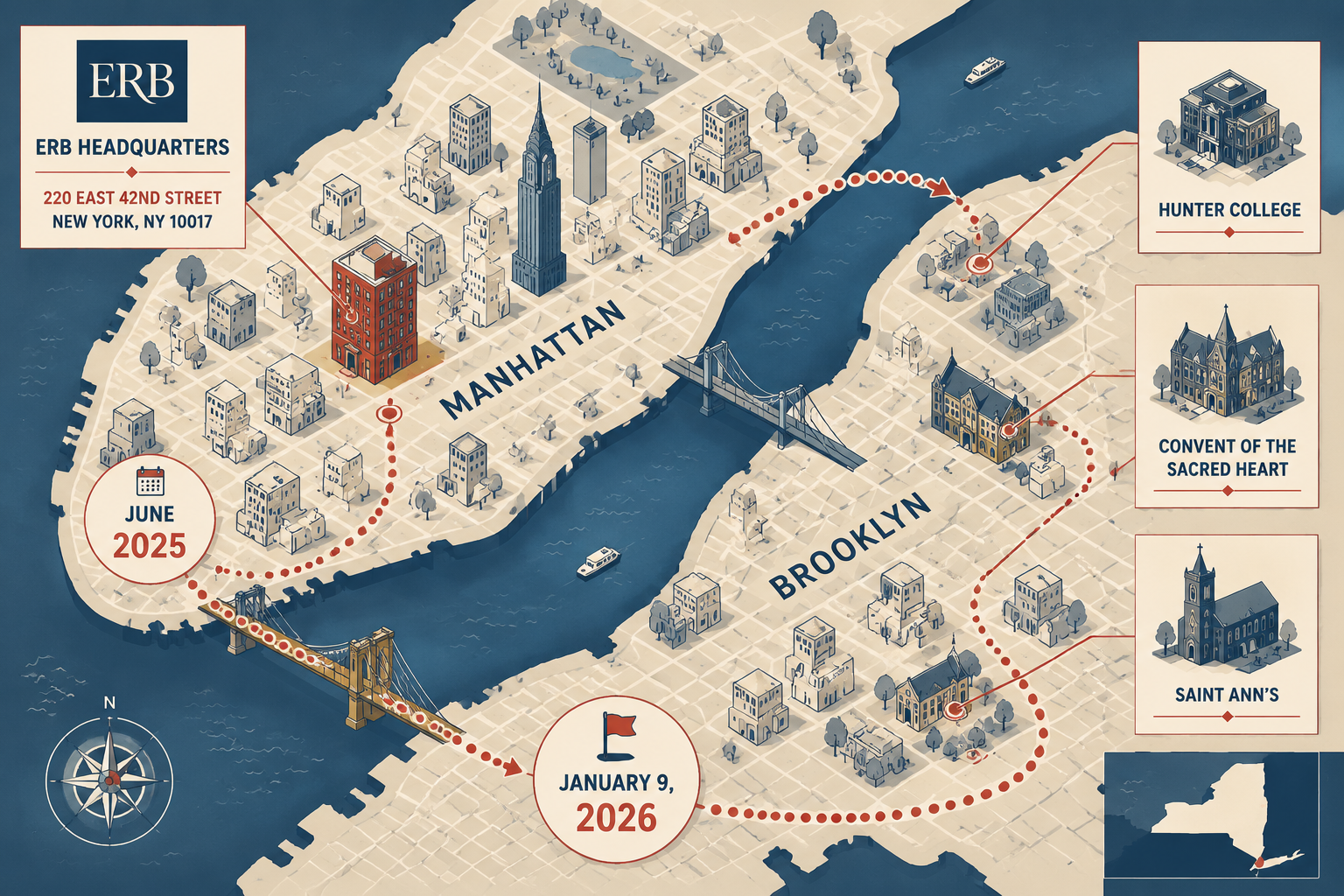
NYC private school admissions run on a compressed calendar. Here is the sequence that matters for families targeting January 9, 2026 — the ISAAGNY ongoing-school deadline.
- June–July 2025: Begin prep. Families starting in June hit the 10–14 week target comfortably before fall test windows. Register for ERB or SSAT.org test dates — NYC centers fill fast.
- September 2025: Open houses begin. Attend information nights, confirm which tests each school requires, and register for your target date if you haven't already.
- October 2025: First ISEE sitting window opens (Aug–Nov season) — the ideal sitting for students aiming to submit scores well before the January deadline. First SSAT Standard Saturdays also become available.
- November 2025: Peak SSAT Saturday dates. School tours and preliminary interviews may begin. Students retaking the SSAT can use this window based on October results.
- December 2025: Final test dates before the application deadline. Applications should be near-complete. Send score reports from ERB and SSAT.org directly to schools via their portals.
- January 9, 2026: ISAAGNY ongoing-school application deadline. All materials — test scores, transcripts, recommendations, essays — due.
- January–February 2026: Student and parent interviews, shadow days, and play dates at target schools.
- February 20, 2026 (approx.): ISAAGNY notification date — schools release admissions decisions.
- Early March 2026: Family response deadline.
A Step-by-Step Prep Framework for NYC Families
- Confirm each school's test requirements. Pull the admissions page for every school on your list before choosing a test. Don't assume — individual school pages at Dalton, Brearley, Horace Mann, and Riverdale specify exactly what they accept.
- Choose ISEE or SSAT based on your school list, retake tolerance, and student profile. SSAT if the list includes boarding schools or if you want retake flexibility; ISEE if you prefer structure and the student tests well under pressure.
- Register early. ERB test centers in NYC — including ERB's own office at 220 East 42nd Street and partner sites like LREI and Léman Manhattan — fill 8–10 weeks out. The same applies to SSAT sites at Hunter College and Convent of the Sacred Heart.
- Take a full-length diagnostic. Official practice tests are available through ERB's family portal and SSAT.org. A proctored diagnostic under real timing conditions tells you far more than a worksheet.
- Build a 10–14 week prep plan. Aim for 60–90 minutes, three times a week. Weeks 1–3: diagnosis and vocabulary building. Weeks 4–8: section-by-section skills work. Weeks 9–12: full-length tests and review.
- Use the "October pilot" strategy for SSAT. Students planning to retake can treat October as a low-stakes diagnostic — real conditions, real stakes, but with a November retake in the plan. This does not work for ISEE.
- Send scores directly through the ERB or SSAT portals once results are available. Don't mail score reports or ask schools to log in somewhere unusual.
- Shift attention to interview prep in November and December. The essay, interview, and school-visit impression matter enormously at schools like Chapin, Browning, and Buckley — test scores open the folder; everything else fills it.
For families considering professional support, GeniusPrep offers a $150 diagnostic session that produces a section-by-section breakdown and a personalized prep roadmap — a useful starting point before committing to a longer engagement.
Score Expectations at Top NYC Schools
No ISAAGNY school publishes a minimum cutoff, and admissions directors are careful to note that scores are contextualized within the full file. That said, the ranges that circulate among experienced NYC admissions consultants are reasonably consistent:
- Trinity, Collegiate, Brearley, Spence: ISEE stanines of 8–9 across all four scored sections. SSAT 90th percentile and above per section.
- Dalton, Horace Mann, Riverdale Country: ISEE stanines of 7–9 are competitive. Strong SSAT scores in the 85th–95th percentile range.
- Fieldston, Nightingale-Bamford, Chapin: Similar ranges; file holism matters more here than at the most selective tier.
- Saint Ann's: Explicitly deemphasizes standardized test scores. A strong creative or intellectual profile can outweigh a modest percentile.
One calibration note on SSAT percentiles: the SSAT norm group consists of students who chose to take the test — a self-selected, highly motivated applicant pool. A 70th percentile SSAT score is not an average result; it beats 70 percent of students who were already trying to get into competitive independent schools. Schools read SSAT scores accordingly.
Practical Logistics: Where to Test in the Five Boroughs
ISEE (ERB) test centers:
- ERB headquarters, 220 East 42nd Street, Midtown
- LREI (Little Red School House & Elisabeth Irwin), Greenwich Village
- Léman Manhattan Preparatory School, Financial District
- Browning School, Upper East Side
SSAT test centers:
- Hunter College, Upper East Side
- Convent of the Sacred Heart, Carnegie Hill
- Saint Ann's School, Brooklyn Heights
Logistics reminders:
- Plan for Saturday MTA disruptions — check the weekend service advisory the Thursday before, and arrive 30 minutes early.
- Bring a parent photo ID, your child's printed admission ticket, two sharpened #2 pencils, and a snack for the break.
- GeniusPrep's Flatiron office at 928 Broadway, Suite 1206 is accessible from the R/W, F/M, and 6 trains at 23rd Street — useful for families who prefer local prep before heading to test centers.
Common Pitfalls NYC Families Make
- Registering too late. NYC test centers close out weeks in advance. Families who decide in mid-September that they want an October ISEE date often find it gone.
- Over-testing on the SSAT. The flexibility to retest is real, but students who take five or six sittings often plateau or regress. More tests don't equal better scores — diminishing returns set in fast.
- Ignoring the essay. Both tests include an unscored essay sent to schools. Admissions offices read it for writing maturity, sentence structure, and voice. A flat, error-prone essay paired with a stanine 8 sends a mixed signal.
- Letting test prep consume the file. Transcripts, teacher recommendations, and the parent statement carry significant weight. As one Dalton-tier admissions director put it, test scores are "the table stakes" — they determine whether a folder is opened, not whether an offer is made.
- Confusing the in-school ERB with the ISEE. Many NYC private K–4 programs administer ERB assessments (CPAA, ECAA, WrAP) each fall. These are teacher-report and skills assessments, not the ISEE. They're related instruments from the same organization, but they aren't interchangeable.
For more on NYC's broader testing landscape — including the SHSAT for specialized high schools — see GeniusPrep's SHSAT prep page.
When to Hire a Tutor
Self-study is genuinely viable for students who score at or above the 80th percentile on a cold diagnostic. Official practice materials from ERB and EMA are strong, and a disciplined student with a motivated parent can close modest gaps on their own.
One-on-one tutoring earns its cost most clearly when there is a specific, identifiable gap — a student scoring stanine 5 in Quantitative Reasoning who needs to reach stanine 7–8 before January. A targeted engagement of 8–12 sessions can close that kind of gap efficiently. GeniusPrep's one-on-one sessions run $125/hour, with a structured diagnostic and parent-update protocol built in. For ISEE candidates specifically, our structured ISEE prep program wraps that diagnostic, a section-by-section plan, and full-length proctored mocks into a single prep arc.
Group classes offer a middle path: lower cost, peer pacing, and accountability — useful for students who self-study poorly but don't need intensive one-on-one attention.
What to look for in any NYC tutor:
- Experience with ISAAGNY admissions specifically, not just generalist test prep
- Full-length proctored mock tests built into the program — not just workbook drills
- Written parent updates after sessions so you can track progress across the prep window
- Familiarity with both tests, in case your school list shifts and you need to switch
For families looking further ahead, see SAT prep and ACT prep — the study habits built during middle school test prep carry forward meaningfully.
Frequently Asked Questions
Should my NYC child take the ISEE or the SSAT? For most ISAAGNY ongoing schools, either is accepted, and the choice comes down to strategy rather than eligibility. Choose the ISEE if you prefer a single, well-prepared sitting per season and your list is weighted toward NYC day schools. Choose the SSAT if you want retake flexibility, or if your child is also applying to boarding programs — Andover, Exeter, Hotchkiss, and similar schools require it.
When is the deadline for NYC private school applications for the 2026–27 school year? The ISAAGNY ongoing-school deadline falls on the second Friday in January. For the 2026 cycle, that is January 9, 2026. Individual schools may set earlier internal deadlines for teacher recommendations — verify directly with each admissions office.
How many times can my child take the ISEE? Once per testing season. There are three seasons per year, so the theoretical maximum is three sittings. In practice, most NYC families applying to January deadlines take one ISEE sitting — in October or November — and submit those results.
What ISEE stanine do top NYC schools look for? Schools don't publish formal cutoffs. Based on what admissions counselors consistently report, the most selective schools — Trinity, Collegiate, Brearley, Spence — expect stanines of 8 or 9 across all four scored sections. Dalton, Horace Mann, and Riverdale are competitive at stanines of 7–9.
Do all NYC private schools require the ISEE or SSAT? No. Saint Ann's School in Brooklyn Heights is the most prominent school that doesn't require standardized testing. Additionally, many NYC ongoing schools waive testing for students already enrolled in their lower school applying to the upper division — "lifers." Always confirm directly with admissions.
When should we start preparing? Most NYC families begin 10–14 weeks before their target test date. For a first sitting in October, that means starting in late June or early July. Starting earlier rarely hurts; starting later than mid-August for an October test creates real time pressure. A diagnostic test is the right first step — GeniusPrep's $150 diagnostic produces a section-level breakdown and a recommended prep path.
What is the difference between the in-school ERB assessment and the ISEE? Many NYC private schools administer ERB assessments (such as the CPAA or WrAP) to enrolled students each fall as diagnostic tools for teachers. These are not the ISEE. The ISEE is a separate admissions exam taken at an external test center. Both come from the same organization, which sometimes creates confusion — but they serve different purposes, and in-school scores are not submitted in place of ISEE scores.
Sources
- ERB / ISEE Official Site — Test Structure, Scoring, Registration
- SSAT / EMA Official Site — Test Dates, Scoring, Sittings Policy
- ISAAGNY — Member Schools and Common Application Timeline
- NCES Private School Universe Survey — NYC Private Enrollment Data
- NAIS — National Association of Independent Schools Admissions Data
Reviewed by the GeniusPrep Tutoring Team — last updated 2026-06-15.


