
The NYC Parent's Complete Guide to ISEE and SSAT Prep for Private School Admissions
Every October, thousands of families across the Upper East Side, Riverdale, and Park Slope face the same high-stakes question: ISEE or SSAT? For parents navigating the famously competitive NYC independent school admissions landscape — where Trinity School on the Upper West Side receives hundreds of applications for a handful of seats and top-tier acceptance rates hover between 10 and 18 percent — that single strategic choice can shape the entire admissions campaign.
This guide breaks down everything NYC families need to know: what each test measures, how the two exams compare head-to-head, which schools lean toward which test, the exact 2026 admissions calendar, and a structured prep framework for students in grades 4 through 11.
What the ISEE and SSAT Actually Are
Both exams serve the same gatekeeping function — they give independent schools a standardized academic snapshot alongside transcripts, recommendations, and interviews — but they come from different organizations and operate under different rules.
The ISEE (Independent School Entrance Exam) is administered by the Educational Records Bureau (ERB), a nonprofit based in New York City. It offers four levels:
- Primary — grades 2–4 entry
- Lower — grades 5–6 entry
- Middle — grades 7–8 entry
- Upper — grades 9–12 entry
The SSAT (Secondary School Admission Test) is administered by the Enrollment Management Association (EMA). It offers three levels:
- Elementary — grades 4–5 entry
- Middle — grades 6–8 entry
- Upper — grades 9–12 entry
Both exams test verbal reasoning, quantitative reasoning, reading comprehension, and math, and both include a writing sample that is sent to schools unscored. The content overlap is substantial — vocabulary and math reasoning form the core of both — but the scoring, retake policy, and strategic implications differ significantly.
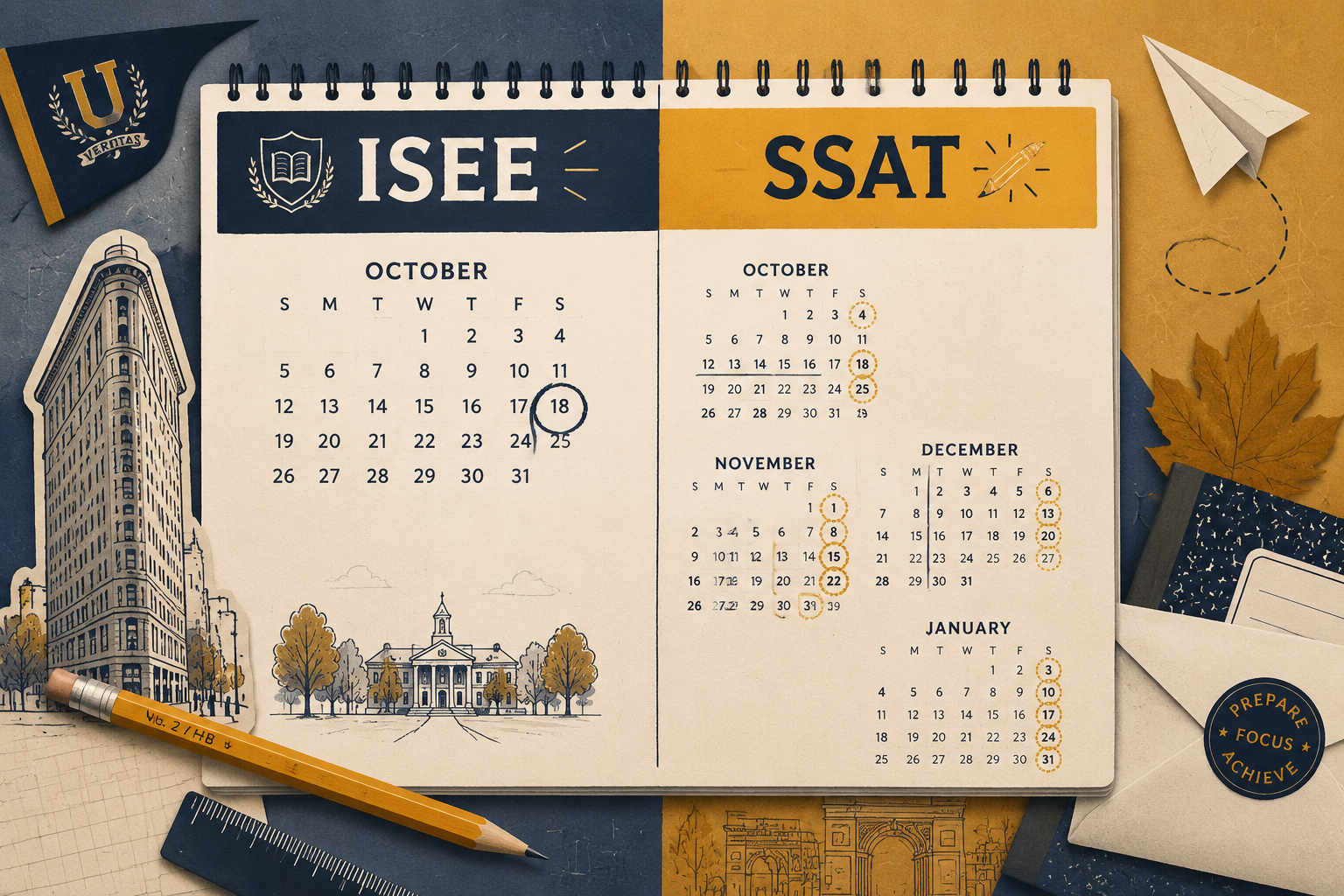
ISEE vs. SSAT: Side-by-Side Comparison
| Feature | ISEE | SSAT |
|---|---|---|
| Administering Body | ERB | EMA |
| 2025–26 Fee | $140 standard | $185 Standard Saturday; $325 Flex |
| Sittings Allowed | 1 per season (3 seasons/year) | Unlimited Standard + Flex |
| Scoring Scale | Stanines 1–9 + percentiles | Scaled 440–710 (Middle); 500–800 (Upper) |
| Sections | Verbal Reasoning, Quantitative Reasoning, Reading, Math Achievement, Essay | Verbal, Quantitative, Reading, Writing |
| Wrong-Answer Penalty | None | −¼ point per wrong answer |
| NYC Test Center | ERB HQ, 40 W 20th St (Flatiron) | Various; rolling Flex options |
| Best For | Single-shot test takers; ISEE-preferring schools | Students who benefit from retake flexibility |
The guess penalty is the most practically important difference. On the SSAT, a wrong answer costs a quarter point, which rewards disciplined skipping over blind guessing. On the ISEE, there is no penalty, so students should always answer every question. This structural difference often makes the ISEE the better fit for students who tend to freeze under uncertainty.
Retake flexibility is the second major differentiator. The ISEE allows one sitting per testing season across three seasons (August–November, December–March, April–July). The SSAT allows unlimited Standard Saturday registrations plus the more expensive Flex option, which is proctored at a designated location on a flexible date. Families who want a safety net typically lean toward the SSAT.
Which NYC Schools Prefer Which Test
Most ISAAGNY member schools — the 140-plus independent schools in the greater New York area — accept both exams. Historically, however, school culture and admissions office familiarity have created soft preferences worth knowing.
ISEE-leaning schools (verify each cycle with the school directly):
- Trinity School (UWS)
- Collegiate School (UWS)
- Brearley School (UES)
- Chapin School (UES)
SSAT-leaning or boarding-pipeline schools (which see more SSAT scores from out-of-state applicants):
- Riverdale Country School (Riverdale)
- Poly Prep Country Day School (Brooklyn)
Accept both with no stated preference:
- Dalton (UES)
- Horace Mann (Riverdale)
- Spence (UES)
- Fieldston (Riverdale)
- Saint Ann's (Brooklyn Heights)
- Berkeley Carroll (Park Slope)
- Friends Seminary (Gramercy)
- Grace Church School (Greenwich Village)
- Avenues: The World School (Chelsea)
The practical advice: build your school list first, then check each school's admissions page. If your list is split, a diagnostic score on both tests — not gut instinct — should drive the final call. GeniusPrep's $150 diagnostic assessment covers both exams and produces a section-by-section breakdown that makes this decision data-driven rather than guesswork.
The 2026 NYC Admissions Timeline
For families targeting the 2026–27 school year, the calendar is tight. Every date below is a real deadline or near-certain projection based on ISAAGNY's historical patterns.
| Month | Action |
|---|---|
| Aug–Sept 2025 | Begin prep; take diagnostic ISEE and SSAT; register for fall test dates |
| Oct–Nov 2025 | First ISEE sitting; SSAT October/November Standard Saturdays |
| Nov–Dec 2025 | School tours, open houses, and student interviews begin |
| Dec 2025–Jan 2026 | Application deadlines for most ISAAGNY schools (mid-December to early January) |
| Jan 2026 | Submit final scores; last SSAT retake window; ISEE Dec–Mar season open |
| Feb 6, 2026 (projected) | ISAAGNY Notification Day — acceptance letters released |
| Feb–Mar 2026 | Waitlist movement; reapplication at schools with rolling admissions |
Register for the ERB's Flatiron testing center at 40 West 20th Street at least six to eight weeks before your target date. October and November slots fill fastest. At-home Prometric testing exists as a backup, but paper-based testing at ERB HQ remains the NYC standard and is what students should practice for.
A 6-Step ISEE/SSAT Prep Framework
Structured prep separates students who plateau at stanine 6 from those who reach stanines 8 and 9 — the range typical of admitted students at Dalton, Brearley, and Horace Mann. Here is the framework GeniusPrep uses with NYC families.
Step 1: Take a diagnostic on both tests. A full-length, timed practice ISEE and SSAT reveals scoring gaps and identifies which test structure suits the student. This is not optional — it is the only objective basis for the ISEE-vs.-SSAT decision.
Step 2: Choose the test. Combine diagnostic results with the target school list. If a student scores comparably on both, default to the ISEE for ISEE-preferring schools, or choose the SSAT if retakes are likely to be needed.
Step 3: Build a 3–6 month study plan. Plan for two to four hours of focused work per week, distributed across all tested sections. Cramming in the final two weeks rarely moves scores at this level.
Step 4: Master the core question types. Vocabulary analogies (SSAT) and sentence completions (ISEE) are high-leverage: they reward consistent reading habits across the full prep period. Quantitative reasoning sections require a solid command of ratios, rates, and basic algebra — not advanced math.
Step 5: Take 2–3 timed, full-length practice tests under realistic conditions. Simulate test-day conditions: timed sections, no phone, no breaks beyond what the real test allows. Score each test, identify error patterns, and adjust the study plan accordingly.
Step 6: Register strategically. Book the ERB Flatiron center early. Plan one potential SSAT retake window if you chose the SSAT. If you chose the ISEE, commit fully to the one sitting — the stakes-management work happens in prep, not in the registration queue.
For families who want ISEE-specific coaching, or who are also weighing high school entrance exams like the SHSAT, GeniusPrep offers individualized plans from the same Flatiron building.
How to Choose a Tutor or Prep Program in NYC
Private school test prep in Manhattan operates across a wide price range: group classes typically run $75–$150 per hour, and 1-on-1 tutoring from experienced instructors runs $200–$500 or more per hour. The price gap is real, but so is the quality gap.
What to look for:
- Diagnostic-first approach. A tutor who hands over a study plan before seeing scores is guessing.
- NYC school knowledge. Familiarity with ISAAGNY schools, ISEE stanine targets, and the admissions calendar is not optional — it changes how you prioritize sections and allocate prep time.
- Updated materials. The ISEE and SSAT release revised question pools periodically. Tutors using prep books from three cycles ago are teaching to a slightly different test.
- Homework accountability. Score gains come from between-session practice, not from the session itself.
Red flags: any tutor who guarantees a score, assigns no homework, or cannot tell you the stanine ranges at your target schools should be crossed off the list.
GeniusPrep's Flatiron studio at 928 Broadway, Suite 1206 sits one block from the ERB testing center — meaning students can walk from their prep session to the actual exam site. Sessions start at $125, and full pricing is available here.
Common Mistakes NYC Families Make
After working with hundreds of NYC families through the admissions cycle, the same errors appear repeatedly.
- Starting too late. Beginning prep after Halloween for February admissions leaves 8–10 weeks at best — not enough to move scores meaningfully at the upper stanines. August or September is the target start.
- Ignoring the writing sample. Schools do read the unscored essay. Admissions officers use it to assess voice, argument structure, and whether it sounds like the student who showed up for the interview.
- Misunderstanding ISEE retake rules. Students cannot retake the ISEE within the same season. Registering twice in October will result in the second registration being voided. One season, one shot.
- Over-indexing on test prep at the expense of the rest of the application. Stanines 8–9 paired with a weak teacher recommendation or a missed school tour is still a weak file. The test is one of roughly five inputs ISAAGNY schools weigh.
- Skipping the diagnostic. Families who choose ISEE vs. SSAT based on what a neighbor's child took — without testing their own child on both — are making a consequential decision without data.
Beyond the Test: What ISAAGNY Schools Actually Weigh
A stanine 9 does not guarantee admission to Dalton or Horace Mann. Competitive applicants understand that test scores are one signal in a holistic review that typically includes:
- Academic transcripts — consistent grades across core subjects
- Teacher and counselor recommendations — often the most candid part of the file
- Student interview — schools are assessing curiosity, self-awareness, and fit
- Parent statement — clarity of why this school for this child
- Character and fit — increasingly measured through the Character Skills Snapshot, which a growing number of ISAAGNY schools have adopted as a supplement or alternative post-2020
Families should also be aware of diversity pipeline programs — Prep for Prep, Early Steps, and the TEAK Fellowship — that place high-achieving students from underrepresented backgrounds at top ISAAGNY schools. Siblings and legacy connections remain factors at many schools, though rarely determinative on their own.
For families weighing the broader high school landscape — including specialized public schools — GeniusPrep's SHSAT prep and SAT prep resources cover those parallel tracks. The GeniusPrep team page introduces the tutors behind each program.
Frequently Asked Questions
Should my child take the ISEE or SSAT for NYC private schools? Both are accepted at most ISAAGNY member schools. Take a diagnostic on both first. Choose the ISEE if your child performs well under single-attempt pressure or is applying to ISEE-preferring schools like Trinity or Collegiate. Choose the SSAT if retake flexibility is a priority or if your school list skews toward boarding-feeder programs like Riverdale Country or Poly Prep.
When should we start prepping for the ISEE or SSAT in NYC? Begin four to six months before your target test date. For February 2026 admissions, that means starting no later than August or September 2025. Families starting in late October are already running behind.
What is a competitive ISEE score for top NYC schools like Dalton or Brearley? Stanines of 8 or 9 across all four scored sections — Verbal Reasoning, Quantitative Reasoning, Reading Comprehension, and Math Achievement — are typical of admitted students at top-tier ISAAGNY schools. A stanine 7 in one section is generally not disqualifying; stanines below 6 in multiple sections are a concern.
Can my child take the ISEE more than once? Yes, but only once per testing season. The three seasons are August–November, December–March, and April–July. Schools generally receive scores from all sittings within the application year, so there is no advantage to taking it twice in one season — and it is not permitted.
Where do NYC students take the ISEE? The primary NYC testing center is ERB's office at 40 West 20th Street in the Flatiron district. An at-home Prometric option exists for families who cannot schedule at the Flatiron center, but in-person testing is the standard students should prepare for.
How much does ISEE or SSAT prep cost in NYC? Group prep classes typically run $75–$150 per hour. Private 1-on-1 tutoring from experienced instructors ranges from $200 to $500 or more per hour in Manhattan. A diagnostic assessment — the right starting point before committing to either test — runs $150 at GeniusPrep.
Do all ISAAGNY schools require a standardized test? Most schools require testing for students entering grade 5 and above, but a growing number have adopted test-optional or test-flexible policies, particularly since 2020. Some now accept the Character Skills Snapshot as an alternative or supplement. Check each school's current admissions requirements directly — policies shift year to year.
What is the application deadline for NYC private schools for the 2026–27 cycle? Most ISAAGNY school applications are due between mid-December 2025 and early January 2026. Score submission should be completed by mid-January 2026. Acceptance notifications are projected for Friday, February 6, 2026 — the traditional ISAAGNY Notification Day.
Sources
- Educational Records Bureau (ERB) — Official ISEE Information
- Enrollment Management Association (EMA) — Official SSAT Information
- ISAAGNY — Independent Schools Admissions Association of Greater New York
- NYSAIS — New York State Association of Independent Schools
- NYC Department of Education — School Enrollment and Choice
Reviewed by the GeniusPrep Tutoring Team — last updated 2026-06-19.


