
Why ISEE and SSAT Prep in NYC Is Unlike Anywhere Else in the Country
Every January, families on the Upper East Side, in Park Slope, and in Tribeca wait for envelopes — or, more often now, a portal notification — from schools like Trinity, Brearley, and Dalton that will determine where their children spend the next several years. NYC independent school admissions are among the most competitive in the country, with many top-tier schools admitting fewer than one in five applicants. The ISEE and SSAT are not the only factors — transcripts, teacher recommendations, interviews, and parent statements all matter — but a strong standardized test score is one of the clearest signals an applicant can send. Understanding which test to take, when to take it, and how to prepare systematically is the first real decision this process demands.
ISEE vs. SSAT: Which Test Do NYC Schools Require?
Most ISAAGNY member schools — the consortium that governs NYC independent school admissions calendars and practices — accept either the ISEE or the SSAT. Families are not locked in. That said, the two tests differ meaningfully in structure, scoring logic, and strategy, and choosing the right one for your child can make a measurable difference.
| Feature | ISEE | SSAT |
|---|---|---|
| Administered by | ERB (Educational Records Bureau) | EMA (Enrollment Management Association) |
| Levels | Primary, Lower, Middle, Upper | Elementary, Middle, Upper |
| Sections | Verbal Reasoning, Quantitative Reasoning, Reading Comprehension, Math Achievement, Essay | Quantitative, Verbal, Reading, Writing Sample |
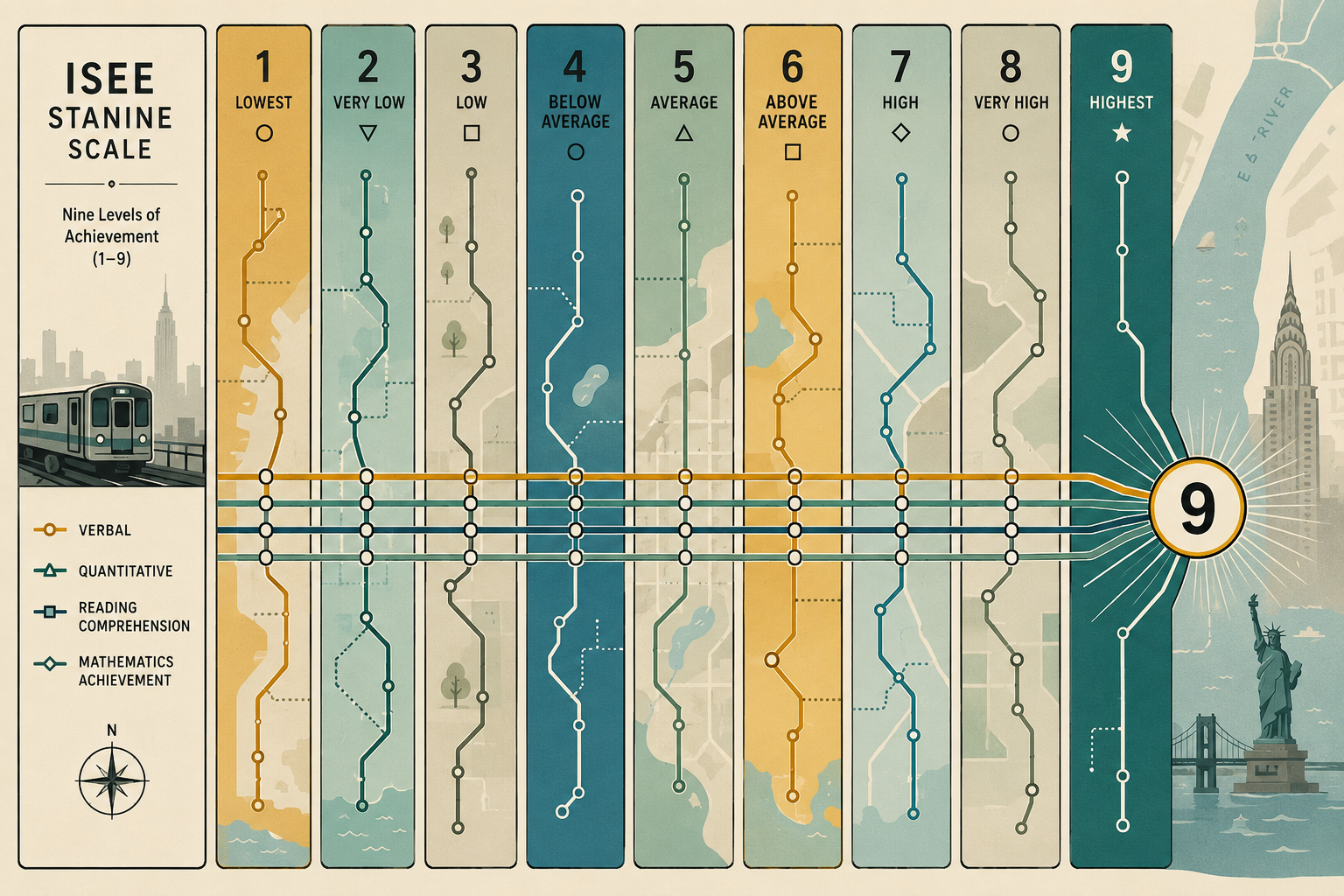
| Scoring system | Stanines 1–9 (schools target 7+ for competitive apps) | Percentiles vs. 3-year national cohort |
| Attempts allowed | Once per season (max 3x per year) | Unlimited (8 Standard Saturdays + Flex dates) |
| Guessing penalty | None | Yes (−¼ point per wrong answer) |
| 2026 test fee | ~$165 | ~$185 |
The ISEE, administered by ERB, tends to favor students who are strong in abstract reasoning and math. Its Quantitative Reasoning section tests logic and problem-solving more than computation, and its stanine score (1–9) is the figure schools focus on most. Competitive applicants at top-tier NYC schools generally present stanines of 7 or above; the most selective schools expect 8s and 9s.
The SSAT, administered by EMA, leans harder on vocabulary — synonyms and analogies form a significant portion of the Verbal section. The guessing penalty changes strategy: students must skip questions they genuinely cannot reason through rather than gamble on them. Percentile scoring compares your child against a specific three-year cohort of test-takers, which can yield different results depending on the year and level.
Specific NYC schools accepting either: Horace Mann, Riverdale Country, Dalton, Nightingale-Bamford, Spence, Chapin, Browning, Allen-Stevenson, Buckley, Friends Seminary, Grace Church, Saint Ann's (Brooklyn), Berkeley Carroll, Packer Collegiate, Poly Prep, Hewitt, and Fieldston all accept both. The choice almost always belongs to the family — and it should be made on the basis of diagnostic data, not assumption.
NYC Admission Entry Points: Which Level Do You Need?
NYC independent schools admit students at several entry points, and the correct test level depends on where your child is entering.
- 5th or 6th grade entry: ISEE Lower Level or SSAT Middle Level
- 7th or 8th grade entry: ISEE Middle Level or SSAT Middle Level
- 9th grade entry: ISEE Upper Level or SSAT Upper Level
A few NYC-specific nuances worth knowing:
- Schools like Trinity and Collegiate have very limited openings outside of Kindergarten and 9th grade. Applicants targeting those schools compete for a small number of spots in a very large applicant pool.
- Horace Mann, Riverdale, and Dalton enroll large 7th and 9th grade cohorts and are among the more common targets for families making their first independent school application.
- Hunter College High School is a public school that uses a completely separate entrance exam — the Hunter test — not the ISEE or SSAT. Families exploring screened public school options should also review SHSAT prep for the Specialized High School Admissions Test, which governs entry to Stuyvesant, Bronx Science, and Brooklyn Tech.
The 2026–27 NYC Admissions Timeline
Getting the timing right is at least as important as the preparation itself. The ISEE limits students to one attempt per testing season, so a poorly timed registration can eliminate a critical second opportunity. Here is the month-by-month calendar for families targeting fall 2027 entry.
| Month | What to Do |
|---|---|
| June–August 2026 | Take a diagnostic; choose ISEE or SSAT; begin tutoring or structured self-study |
| September 2026 | Attend school open houses (Dalton, Brearley, and Trinity host fall events); finalize school list |
| October 2026 | First ISEE or SSAT attempt; ISAAGNY applications typically open |
| November 2026 | Schedule school visits and interviews; begin parent statement draft |
| December 2026 | Second test attempt if needed; submit teacher recommendation requests |
| January 9–15, 2027 | ISAAGNY application deadline for most member schools |
| February 2027 | Interviews continue; final ISEE attempt window opens (Apr–Jul season) |
| March 10, 2027 | ISAAGNY notification date — the "March 10 letter" |
| March 11–15, 2027 | Revisit days and contract deadlines (~10 days post-notification) |
Starting prep in June or July — roughly nine to twelve months before the application deadline — gives families room to run a diagnostic, build a deliberate plan, take the test in October, and still have a December or February safety-net attempt if the first score falls short.
A Step-by-Step ISEE/SSAT Prep Framework for NYC Families
Families who navigate this process most smoothly tend to follow a recognizable sequence. Here is the framework we use at GeniusPrep — the same one behind our ISEE prep program.
Diagnose first. Take an official ERB or SSAT practice test 9–12 months before your target deadline. A baseline stanine or percentile tells you exactly how far you need to move and where to focus energy. Our diagnostic session ($150) pairs the scored practice test with a personalized plan.
Choose your test. Math-strong, logical reasoners often outperform on the ISEE. Students with wide reading vocabularies tend to score better on the SSAT. A diagnostic of both tests eliminates the guesswork.
Set a realistic score target. Top-tier schools like Trinity, Brearley, Collegiate, and Horace Mann expect stanines of 8–9 from highly competitive applicants. Tier-two schools like Riverdale, Nightingale-Bamford, and Berkeley Carroll commonly admit students in the 6–8 stanine range. Knowing your target determines how aggressively you need to prep.
Build a 12–16 week study plan. Plan for 3–5 hours per week of structured, focused work — timed drills on specific question types, not passive rereading of prep books.
Address section weaknesses directly. Quantitative Reasoning (ISEE) and Verbal Reasoning (both tests) are the sections most responsive to coaching. Reading Comprehension improves more gradually but rewards consistent work with dense, timed passages.
Take a full proctored mock every 3–4 weeks. Simulated conditions — timed, distraction-free — produce the most accurate progress data and systematically reduce test-day anxiety.
Schedule the real test strategically. Aim for October as your first attempt. That preserves December as a second opportunity and February as an emergency third window, all well before January deadlines.
Submit your best score. The SSAT allows families to choose which score reports to send. The ISEE sends all attempts within a cycle — one more reason to enter the first sitting prepared.
Score Targets at Top NYC Independent Schools
No NYC independent school publishes a minimum score cutoff, and admissions directors mean it when they say scores are one factor among many. That said, patterns are consistent enough to plan around.
Tier 1 Schools
Trinity, Brearley, Collegiate, Horace Mann, Spence, Dalton
- ISEE stanines: 8–9 across most sections
- SSAT: 90th percentile or above
- At these schools, a strong test score functions more as a floor than a differentiator. Scores keep an application in consideration; everything else determines the outcome.
Tier 2 Schools
Riverdale Country, Fieldston, Nightingale-Bamford, Chapin, Browning, Berkeley Carroll
- ISEE stanines: 6–8
- SSAT: 75th–90th percentile
Tier 3 / Strong Programs
Friends Seminary, Grace Church School, Léman Manhattan, Avenues
- ISEE stanines: 5–7
- SSAT: 60th–80th percentile
- These schools are sometimes underestimated by families chasing brand names; they offer rigorous academics and deserve genuine consideration.
According to NAIS research, NYC K–12 independent school tuition averaged $62,000–$67,000 for the 2025–26 year, which makes the admissions process feel proportionately high-stakes. But it is worth remembering that test scores open the door; teacher recommendations, interviews, and the student's own voice are what walk through it.
Practical NYC-Specific Prep Advice
A few things rarely appear in prep guides but matter significantly in practice.
Test site logistics are real. The ISEE is offered at Prometric centers throughout the five boroughs and at select schools. SSAT Saturday administrations are frequently hosted at Trinity School on the Upper West Side, Riverdale Country School in the Bronx, and Saint Ann's School in Brooklyn Heights. Register for a site in your own borough when possible — one fewer subway transfer on test morning eliminates a genuine source of stress.
Coordinate with your current school early. Many NYC K–8 independent schools — Grace Church, Saint Ann's, Packer Collegiate, and Friends Seminary among them — have placement directors who communicate directly with admissions offices and can guide timing. Start that conversation in the spring of the year you plan to apply.
Public-to-private transitions require targeted preparation. Students at G&T programs, Anderson School, and NEST+m often arrive with strong classroom records but are caught off guard by the ISEE Quantitative Reasoning section, which tests abstract reasoning concepts outside NY State math standards. Intensive vocabulary work for Verbal Reasoning is similarly important for many public school applicants.
Anxiety affects performance more than families expect. Many strong students underperform on a first attempt simply because of unfamiliarity with the format and the weight of the moment. Booking a low-stakes October sitting — rather than waiting for a "perfect" preparation window — typically produces better results than a single high-pressure attempt close to deadline.
GeniusPrep's Flatiron office at 928 Broadway, Suite 1206 is a central hub for families across the UES, UWS, Tribeca, Brooklyn Heights, and Park Slope, all within easy reach of the 6, N, R, and F trains. See our current program options and pricing to understand how structured prep fits your timeline and budget.
Choosing an ISEE or SSAT Tutor in NYC
NYC offers no shortage of test prep options, and price variation is substantial.
Group classes ($1,200–$3,000 for a multi-week course) work well for motivated, self-directed students who benefit from structured schedules and peer accountability. Quality varies widely — ask specifically whether the instructor has hands-on ISEE and SSAT experience, not just SAT prep or ACT prep backgrounds applied to younger students. The question types, timing structures, and strategies differ enough that expertise does not transfer automatically.
Private 1:1 tutoring ($200–$500/hour in Manhattan) allows fully personalized pacing and works better for students with specific, identifiable weaknesses or families with scheduling constraints. The right tutor should be able to show you — within the first session — exactly where your child stands and what a realistic improvement arc looks like.
Before committing to any program, ask for a sample diagnostic. Any reputable tutor or program should be able to back its approach with data, not just testimonials.
Frequently Asked Questions
Should my child take the ISEE or the SSAT for NYC private school admissions?
Most ISAAGNY member schools accept either, so the decision should rest on your child's academic strengths. The SSAT leans heavily on vocabulary and carries a guessing penalty; the ISEE has no guessing penalty and features a stronger abstract reasoning component in its Quantitative Reasoning section. The most reliable approach is to take a diagnostic of both — ideally with a tutor who knows both tests well — and let the scores decide.
How many times can my child take the ISEE in a single admissions cycle?
ERB allows one ISEE attempt per testing season. There are three seasons per year — August through November, December through March, and April through July — so a student can sit for the ISEE up to three times in a given admissions cycle. Schools generally receive scores from all attempts within the cycle, not just the highest.
What ISEE stanine score do I need for Trinity, Brearley, or Collegiate?
Highly competitive applicants at these schools typically present stanines of 8 or 9 across most sections. No school publishes a formal cutoff, and a perfect score is not an admission guarantee — strong teacher recommendations, a compelling interview, and genuine intellectual curiosity all contribute meaningfully. Think of an 8 or 9 stanine as a threshold that keeps an application fully in consideration, not a ticket to acceptance.
When is the application deadline for NYC private schools for fall 2027 entry?
Most ISAAGNY member schools set application deadlines between January 9 and January 15, 2027, for fall 2027 entry. The standard notification date — referred to by NYC families simply as the "March 10 letter" — is targeted for March 10, 2027, with contract deadlines typically falling about ten days later.
Where can my child take the ISEE or SSAT in New York City?
The ISEE is offered at Prometric testing centers throughout the five boroughs and at select member schools. The SSAT's Standard Saturday administrations are commonly hosted at Trinity School on the Upper West Side, Riverdale Country School in the Bronx, and Saint Ann's School in Brooklyn Heights. Check the official ERB and SSAT websites for current registration windows and site-level availability, as hosted sites vary by year.
How long should we prepare for the ISEE or SSAT?
Most NYC families benefit from 12–16 weeks of structured preparation at 3–5 hours per week, beginning 9–12 months before the application deadline. Starting earlier creates space for a diagnostic, a deliberate study plan, and multiple test attempts if needed — particularly important for the ISEE, where each sitting opportunity is limited.
Do public school students need more preparation than private school applicants?
Often, yes. The ISEE Quantitative Reasoning section tests abstract reasoning concepts not covered in NY State math standards, which can disadvantage even academically strong students from G&T and screened programs. Both the ISEE and SSAT also demand academic vocabulary that benefits from targeted study beyond what most school curricula provide. With sufficient preparation time, public school students compete successfully at all tiers of NYC independent school admissions.
How much does ISEE or SSAT tutoring cost in NYC?
Group preparation programs typically run $1,200–$3,000 for a multi-week course in Manhattan. Private 1:1 tutoring ranges from $200 to $500 per hour depending on tutor specialization and experience. The right investment depends on the gap between a student's baseline score and target — a student who needs to move two stanines in twelve weeks requires more intensive support than one already near target and refining.
Sources
- ERB — ISEE Official Information for Families
- SSAT — Enrollment Management Association
- ISAAGNY — Independent Schools Admissions Association of Greater New York
- NAIS — National Association of Independent Schools Research
- NCES — National Center for Education Statistics, Private School Universe Survey
Reviewed by the GeniusPrep Tutoring Team — last updated 2026-06-18.


